
 Sizing & procurement
How to size a containerized sewage treatment plant
A step-by-step walk from population and per-capita allowance to average daily flow, peak flow, tank volume and finally the container footprint.
 Process & biology
MBR vs MBBR vs SBR: choosing a process
MBR, MBBR and SBR compared on footprint, effluent quality, energy, operation and the flow range each one suits.
- Sizing & procurement
What actually fits in a shipping container
Why the 2.352 m nominal internal width decides the shipping route for an assembled treatment unit, and how to estimate the loading before asking for a freight rate.
 Operations & compliance
Effluent standards and the process train they imply
Reading the GB 18918-2002 grades as a design instruction — what each limit demands of the process, and where reuse and export standards change the answer.
 Incineration & flue gas
How to size a medical waste incinerator
Daily waste output first, then a seasonal margin and the hours the unit will run — the order that turns a waste record into an hourly rating and a published model.
- Incineration & flue gas
Why incinerators run at 850 °C for two seconds
What the 850 °C and two-second figures specify, why they matter for dioxin destruction, and how the gas train stops the same compounds re-forming downstream.
- Incineration & flue gas
Incineration vs autoclave vs microwave: choosing a medical waste treatment method
Three on-site treatment routes compared on what they actually do to the waste, what each leaves behind, and the site conditions that decide between them.
- Process & biology
What the zones of an A²/O plant remove
The anaerobic, anoxic and aerobic zones each hold a different set of conditions, and the order they sit in is what makes nitrogen and phosphorus leave the water.
- Sizing & procurement
How to specify a packaged sewage treatment plant
The inputs a supplier has to hold fixed before a number is a price: design flow, peak factor, influent quality, discharge grade, tank volume, box dimensions and site conditions.
- Sizing & procurement
Reading design influent quality: what the numbers decide
A survey mean and an 80th percentile answer different questions, and the per-capita load basis is a third; using the wrong one changes both the tank volume and the process.
- Operations & compliance
Commissioning and operating a packaged plant
What arrives pre-tested and what does not, the order commissioning runs in, how the biology is started, and what a daily and weekly round has to look at.
- Operations & compliance
Hospital and clinic wastewater: what is different
Why a small flow carries a heavy duty, and how pathogens, ammonia, contrast media and disinfectants change the process a hospital plant has to run.
- Sizing & procurement
Power and site conditions when a plant ships abroad
Frequency, voltage, phase, generator supply, climate and spares — the site data an export plant has to be matched to before the offer is fixed.
- Operations & compliance
Coagulation and flocculation: dosage and the jar test
What coagulation and flocculation each do, the three chemical families, why the dose cannot be read from a table, and the jar test that sets it.
- Sizing & procurement
Skid-mounted vs containerized vs civil works
Three ways to buy a plant — on a skid, inside a container, or built on site — and the boundary conditions that decide which one the project should take.
- Process & biology
Activated sludge process: diagram and four design decisions
How the activated sludge process works, with a flow diagram, six steps, design formulas and a worked example linking sludge age, F/M, return sludge and tank volume.
- Sizing & procurement
Equalization tanks: sizing for peak flow and peak load
What a wastewater equalization tank buffers, why the volume comes from a flow record rather than a rule of thumb, and where peak load disagrees with peak flow.
- Process & biology
Grit removal in wastewater treatment: why it sits in front
What grit is, what it costs when it is not taken out, and how a grit chamber in a wastewater treatment plant is sized for the flow it has to handle.
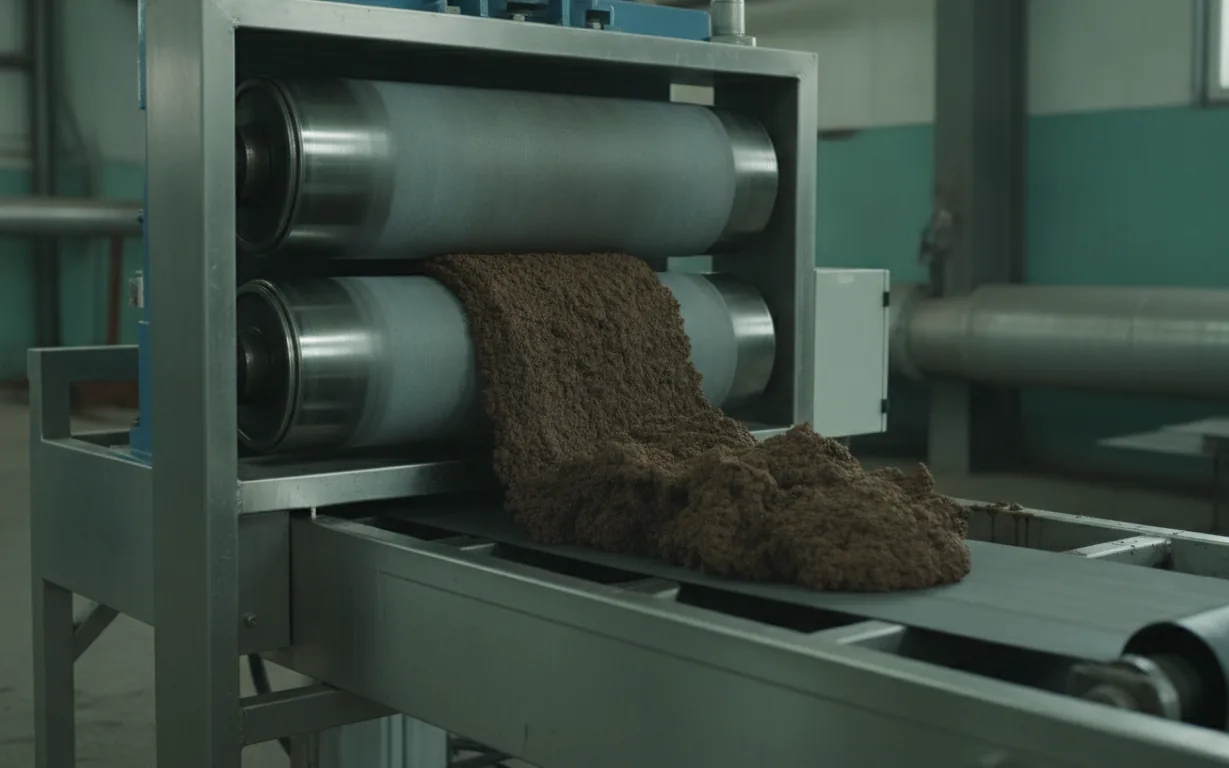 Sludge
 thickening before dewatering: why, and which method
What thickening takes off the load on a dewatering unit, the three thickening routes — gravity, dissolved air flotation and rotary drum — and what decides between them.
- Incineration & flue gas
Flue gas treatment in an incinerator: quench, scrub, adsorb, filter
The four duties a gas train performs after the combustion chamber — cooling, acid-gas scrubbing, adsorption and particulate filtration — and what each stage removes.
- Process & biology
Membrane fouling: four mechanisms and what each one needs
Cake layer, pore blocking, organic adsorption and inorganic scaling: how each one forms, and why the shape of the transmembrane pressure curve names the mechanism that is running.
- Process & biology
Membrane cleaning: the chemicals, and how frequency is set
Maintenance and recovery cleaning, the three chemical families — hypochlorite, acid and alkali — and why the interval between cleans follows the transmembrane pressure trend and not the calendar.
- Process & biology
MLSS and MLVSS in wastewater: what the two numbers count
What an MLSS wastewater reading includes, what the volatile fraction adds, how the sample is taken, and what the ratio between the two numbers says about the biology.
- Process & biology
COD vs BOD: what the ratio tells you about treatability
What the COD and BOD tests each measure, why the BOD to COD ratio is read as a first estimate of biodegradability, and the cases in which the ratio misleads.
- Process & biology
F/M ratio and sludge age: the two dials of an activated sludge plant
How the food to microorganism ratio and the sludge age describe one balance from two sides, how each dial is actually turned, and what going too far in either direction looks like.
- Sizing & procurement
Surface loading rate and hydraulic loading rate: sizing a settling tank
How the surface loading rate decides what a settling tank removes, why depth does not change it, and the one case where the hydraulic loading rate is a different number.
- Sludge
Sludge drying beds vs mechanical dewatering: which site, which route
An open sand bed and a machine both turn liquid sludge into a cake. They buy that result in different currencies, and the site decides which one it can pay in.
- Sludge
Sludge moisture content: what 80% versus 65% costs downstream
The same dry solids, two cakes, and a difference that is paid for at every trip, every gate fee and every handling step after the plant gate.
- Process & biology
Fenton oxidation: when the reaction is worth its cost
The reagent bill, the iron sludge it leaves and the point at which a chemical stage beats the alternatives — read as a cost question rather than a chemistry one.
- Incineration & flue gas
Rotary kiln incinerator vs grate vs pyrolysis: choosing a type by waste
Three furnace types sorted by what they do to the feed: the rotary kiln that turns containerised waste over, the grate that carries bulk refuse through, and the starved-air unit that splits the process in two.
- Incineration & flue gas
Waste calorific value: what the feed decides about the furnace
How the heat in the waste sets the auxiliary fuel, the chamber volume and the throughput a furnace can actually take, and how to get the figure for your own feed.
- Incineration & flue gas
Dioxin formation after the furnace: de novo synthesis and the quench window
Most of the dioxin your stack test measures was made after the flame, on the fly ash. The two reaction routes, the temperature window they share, and what to write into the specification so your cooling section closes it.
- Incineration & flue gas
Activated carbon injection: mercury and dioxin removal before the bag filter
What powdered carbon is dosed for, how an injection rate is set when no table gives it, and why the bag filter behind the lance is part of the adsorption stage.
- Incineration & flue gas
SNCR vs SCR: removing NOx from a small incinerator
The two reagent routes to NOx control, the temperature window each one needs, why a waste-gas catalyst is poisoned, and what the choice costs a small plant.
- Incineration & flue gas
CEMS: continuous emission monitoring on a medical waste incinerator
What a CEMS measures continuously, which parameters are sampled instead, what the data is used for, and why the oxygen reading decides what every other figure means.
- Process & biology
Extended aeration process: 20–30 day sludge age, 18–36 h retention
What the extended aeration process does differently, why the long sludge age is the design intent rather than a side effect, and where it stops paying. The design numbers are a 20–30 day sludge age and 18–36 hours of retention.
- Sizing & procurement
Per capita water consumption: why it cannot size an industrial plant
Per capita water consumption is a municipal allowance, not a plant figure. What the allowance assumes, why an industrial site has no population to count, and what to measure in its place.
- Process & biology
Slaughterhouse wastewater: the pre-treatment before the biological stage
Blood, fat, hair, paunch and ammonia: what a slaughterhouse discharges, which of it has to come out before the biology, and what the biological stage should be handed.
- Operations & compliance
Aeration blowers in wastewater treatment: maintenance and the electricity bill
What the aeration blower has to do, the maintenance that prevents failures, and the checks that turn the largest electricity line on a biological plant into a number somebody manages.
- Process & biology
Internal and external recycle ratios: how each one is set
The two recycle lines in an activated sludge plant carry the same name and do different jobs. How each ratio is derived from a figure you can measure, and what running it too hard looks like.
- Sizing & procurement
Source water decides the water treatment process
The train is set by five parameters in the raw water rather than by the country it comes from, and each parameter adds one identifiable step.
- Incineration & flue gas
Hospital waste incineration: reading the WHO technology ladder
WHO’s 2019 overview of health-care waste treatment technologies sorts the options into three tiers. Where a hospital’s incinerator sits decides what the site can honestly claim about it.
- Sizing & procurement
Dissolved air flotation working principle: two details that decide dry oil or watery sludge
Air is dissolved into a pressurised stream, released as micro-bubbles and floated up with the oil. The mechanism is the easy half — where the oil leaves the tank decides what it costs to get rid of.
- Incineration & flue gas
Inside a two-chamber incinerator: a 2017 patent walkthrough
A 2017 utility model sets out the whole gas path of a small two-chamber incinerator, stage by stage, in two drawings. It is still a useful teaching aid — including where its order differs from the one used today.
- Incineration & flue gas
Small incinerator flue gas treatment: a full train in a small furnace
A large waste-to-energy plant and a packaged incinerator clean gas with the same unit operations. What changes when the train is shrunk, and where a small plant can still lose the standard.
- Incineration & flue gas
Small incinerator cost: on-site incineration against a central plant
A packaged incinerator is cheaper to buy than a central plant and more expensive to run per tonne. Whether it pays depends on four local numbers.
- Incineration & flue gas
Small waste incinerator installation: the twelve steps from delivery check to first firing
A small incinerator arrives as modules, not as a machine. What the site does between the delivery truck and the first load of waste: check, assemble, wire, preheat.
- Incineration & flue gas
Medical Waste Incinerator Emission Standards by Country
How to read medical waste incinerator standards, plus a country index linking each jurisdiction to the separate emission-standards lookup. This guide explains scope, oxygen correction and evidence handover; the lookup carries the numerical country tables. Permits and current law still need project-level confirmation.
- Sizing & procurement
How to Size an Automatic Polymer Dosing System
Start from the equipment and the control functions, separate the dose basis for water treatment from sludge dewatering, and check PAM consumption, working-solution demand and preparation capacity with a worked example.
- Operations & compliance
What is an IPAL? Indonesia’s domestic wastewater limits explained
IPAL is Indonesia’s term for a wastewater treatment plant. Under Permen LH No. 11/2025, the limit depends on the discharge route and, for discharge to water media, the daily wastewater volume.
- Sizing & procurement
How to vet a wastewater treatment equipment supplier: 12 questions that decide a project
Twelve questions to put to every candidate on a shortlist, the answer standard each one has to meet, and the one row where our own record is still open.
- Sludge
Screw press, belt press, plate-and-frame or vacuum belt: choosing a sludge dewatering machine
Four machine families compared on structure, scale, utilities, maintenance and the sludge each one suits, with a decision path that starts from the sludge rather than the catalogue.
- Sizing & procurement
Sewage treatment plant contractor or equipment supplier: who selects, who signs, who carries the risk
Three procurement routes compared — a Saudi platform company and its contractors, Indonesian local government implementation, and Philippine franchisees, LGUs and water districts — with the documents a tender expects and the line between design and supply.
- Operations & compliance
NOM-001-SEMARNAT-2021: what Mexico limits in a discharge
What the current Mexican discharge standard covers, the limits by receiving body, what changed from the 1996 edition, and when each block took effect.
- Operations & compliance
NOM-002-SEMARNAT-1996: limits before the sewer
What the Mexican sewer-discharge standard limits, the full parameter table, pH and temperature, the sampling schedule, and the dates each municipality had to comply.
- Operations & compliance
NOM-003-SEMARNAT-1997: quality for reused water
What the Mexican reuse standard requires of treated water used in public services, the difference between direct and indirect contact, and the sampling regime behind the numbers.
- Operations & compliance
Philippines effluent standards: DAO 2016-08 and the 2021 update
How the Philippines sets effluent limits by water body class, what DAO 2021-19 changed for six parameters, and the rules for strong wastewater and monitoring relief.
- Operations & compliance
Resolución 0631 de 2015: Colombia discharge limits explained
How the Colombian discharge standard picks a limit: four load tiers for domestic wastewater, the Article 15 default for industry, and the 1.50 relief for sewer discharges.
- Sizing & procurement
What is a PTAR? It is the Spanish term for a wastewater treatment plant
PTAR is the Spanish acronym for a wastewater treatment plant. What the four letters cover, the five duties behind them, the four build formats, and what fixes the design.
- Incineration & flue gas
What is a medical waste incinerator and how does it work?
Two chambers with different jobs, the three stages inside the first one, and why the gas is held at 850 °C for 2.0 seconds before it is cleaned.
- Operations & compliance
Wastewater discharge limits compared: Mexico, the Philippines and Colombia
Three national instruments that ask three different questions before giving a number: the receiving body, the water body class, or the activity and its load.
- Operations & compliance
Saudi wastewater discharge limits: coastal water, surface water and land
Saudi Arabia’s aqueous-media regulation uses different tables for coastal and marine water, surface water, and soil or land. The averaging period is part of every limit.
- Operations & compliance
Thailand building effluent standards 2024: the ก, ข, ค and ง classes
Thailand replaced its 2005 building effluent notice in 2024. Two notices published the same day do two different jobs: one sets the limits and the classes, the other designates which buildings are controlled.
- Sizing & procurement
Campus and dormitory water treatment in Thailand: from source to tap
A campus rarely has one water problem. Reading the source, the storage tank and the point of use in that order is what separates a filtration job from a disinfection job.