
Basis
ISO 668:2020 classifies series 1 freight containers by external dimensions, specifies ratings (maximum gross mass) and gives minimum internal and door dimensions for certain types; the authoritative internal dimensions are defined in ISO 1496-1. Its current Chinese adoption is GB/T 1413-2023, and the 2008 edition is abolished. The nominal internal dimensions and capacities in the table are carrier equipment specifications, not ISO table values, and the payload figures are conservative net-payload estimates from carrier data rather than ratings. There is no ready-made authoritative loading table, so the loading algorithm below is our own method: the 0.10 m side and 0.15 m top allowances, the floor formula and the route-classification threshold are site rules, not ISO or carrier rules.
Container internal dimensions
Nominal internal dimensions and capacities are carrier equipment data. Payload is a conservative net-payload estimate, not the ISO rating.
| Container | Internal dimensions (m) | Volume | Payload |
|---|---|---|---|
| 20GP — 20 ft general purpose | 5.898 × 2.352 × 2.393 | about 33.2 m³ | net payload estimate about 28,000 kg |
| 40GP — 40 ft general purpose | 12.032 × 2.352 × 2.393 | about 67.7 m³ | net payload estimate 26,500 kg |
| 40HC — 40 ft high cube | 12.032 × 2.352 × 2.698 | about 76.3 m³ | set by the carrier and the CSC plate; confirmed per booking |
Internal dimensions and capacities are nominal carrier equipment specifications, not ISO 668 table values; a pallet-wide or modified container can differ. For the 20GP row, the 5.898 m length equals the ISO 668 minimum internal length reproduced in the carrier tables, while the width and height are carrier nominal values; the row as a whole is a working dimension set, not an ISO 668 table row. GB/T 1413-2023, which adopts ISO 668:2020, is the current edition, and GB/T 1413-2008 is abolished. Payload is a conservative net-payload estimate, meaning the rating minus tare and then rounded down, not the rating itself. The 40HC payload is set by the carrier and the CSC plate and is confirmed per booking. Verify every figure against the container actually booked.
Loading algorithm
Effective loading space = internal dimensions − packing and lashing allowance (0.10 m on each side, 0.15 m on top). Units per container = floor(length) × floor(width) × floor(height). Take the smaller of the container count by volume and the container count by payload. Equipment is heavy cargo, so the payload limit usually binds first. The allowance, the floor formula and this single-orientation method are our engineering rules, not ISO or carrier rules; the linked calculator also tries both plan orientations. The single orientation of this chart is its conservative special case.
Route classification and fit boundaries
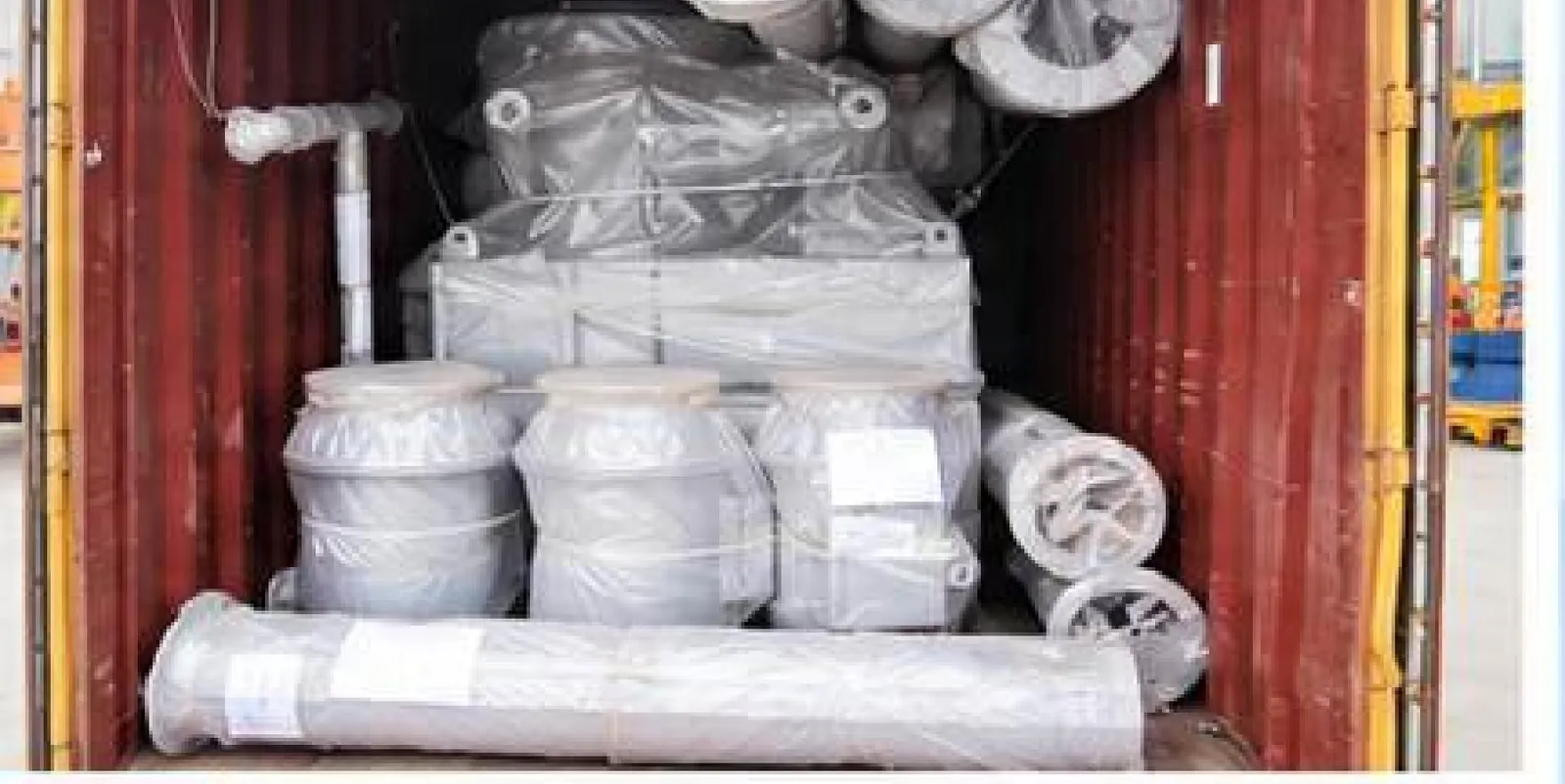
Any unit wider than 2.2 m needs a route check: 2.2 m is our route-classification threshold, not a fit guarantee. The algorithm deducts 0.10 m on each side, so the effective internal width is 2.152 m. When the shorter plan side of a unit is between 2.152 m and 2.2 m, neither plan orientation fits the effective space, even though the door opening is wider; a unit such as 2.18 × 1.0 m can still be turned and loaded, so test both plan orientations. Height has no fixed site threshold here: the effective height after the 0.15 m top allowance and the actual door opening decide, and the door opening is smaller than the internal height; confirm the actual door height and the booking. A unit that does not fit the effective space may still need a 40 ft open-top (OT) or flat-rack (FR) container, break-bulk, or splitting before it leaves our factory. "Containerized" in supplier literature usually means the unit has its own box-like shell and can travel on a flat rack; it does not mean it fits a standard dry container.
Where these figures come from, and how to use them
The table gives the quick lookup values. This section explains what the standards do and do not fix, where the carrier data takes over, how to choose within the values for a real quotation, and where the method stops applying. Value sources and explanation sources are kept separate: a carrier specification that supplies a dimension does not explain the loading method.
What the standards cover
ISO 668:2020 and GB/T 1413-2023Official standard scope
- What it is for
- The standards define the container class, its external dimensions and its rating, which is the maximum gross mass. They also give minimum internal and door dimensions for certain types, and the authoritative internal-dimension specification is ISO 1496-1.
- Why the value is stated this way
- ISO 668:2020 classifies series 1 freight containers by external dimensions, specifies ratings and gives minimum internal and door dimensions for certain types where appropriate. GB/T 1413-2023 adopts ISO 668:2020 and is the current Chinese edition; GB/T 1413-2008 is abolished. ISO 1496-1 is the specification and testing standard that defines the internal dimensions.
- How to choose
- Use the standards to establish the class, the rating and the minimum envelope. Read the nominal internal dimensions, capacity and payload from the carrier equipment specification for the container actually booked.
- When not to use it
- The nominal internal dimensions, capacity and payload in the table are not ISO 668 table values. Do not cite a rating as a payload, and do not use the abolished 2008 edition.
Value source:ISO 668:2020, Series 1 freight containers — Classification, dimensions and ratingsISO 1496-1:2013, Series 1 freight containers — Specification and testing — Part 1: General cargo containers for general purposesGB/T 1413-2023, Series 1 freight containers — Classification, dimensions and ratingsGB/T 1413-2008 (abolished)
Explanation basis: Engineering interpretation of the standard scope
20GP nominal internal dimensions and capacity
5.898 × 2.352 × 2.393 m; 33.2 m³Carrier equipment specification
- What it is for
- These are the inside measurements and the nominal capacity of a steel 20 ft general-purpose container, used to compute the effective loading space.
- Why the value is stated this way
- Carrier tables give slightly different nominal values: Maersk 5.896 × 2.350 × 2.393 m and Hapag-Lloyd 5.900 × 2.352 × 2.393 m. The table uses 5.898 m, the ISO minimum length reproduced on Hapag-Lloyd p.4, with the carrier nominal width and height. The 33.2 m³ capacity is the carrier-published figure and the product of the rounded dimensions is 33.196 m³, so the capacity is not labelled as derived.
- How to choose
- Use the carrier specification for the container actually booked. The small carrier spread matters when a unit is close to a limit.
- When not to use it
- The 20GP row is a carrier/working dimension set, not an ISO 668 table row: its 5.898 m length equals the ISO minimum internal length, while the width and height are carrier nominal values. Do not present the whole row as an ISO table value, and confirm the booked container.
Value source:ISO 668:2020, Series 1 freight containers — Classification, dimensions and ratingsMaersk dry container equipment specificationsHapag-Lloyd container specification
Explanation basis: Engineering interpretation of the carrier data
40GP nominal internal dimensions and capacity
12.032 × 2.352 × 2.393 m; 67.7 m³Carrier equipment specification
- What it is for
- These are the inside measurements and the nominal capacity of a steel 40 ft general-purpose container, used to compute the effective loading space and the plan count.
- Why the value is stated this way
- Carrier tables give Maersk 12.032 × 2.350 × 2.393 m and Hapag-Lloyd 12.032 × 2.352 × 2.395 m. The table uses the Maersk height. The 67.7 m³ capacity is the carrier-published figure and the product of the rounded dimensions is 67.720 m³, so the capacity is not labelled as derived.
- How to choose
- Use the carrier specification for the container actually booked and check the height variant if the unit is close to the effective height.
- When not to use it
- Not an ISO 668 table value; a modified container can differ.
Value source:Maersk dry container equipment specificationsHapag-Lloyd container specification
Explanation basis: Engineering interpretation of the carrier data
40HC nominal internal dimensions and capacity
12.032 × 2.352 × 2.698 m; 76.3 m³Carrier equipment specification
- What it is for
- These are the inside measurements and the nominal capacity of a steel 40 ft high-cube container, used to compute the effective loading space and the volume ceiling.
- Why the value is stated this way
- Carrier tables give Maersk 12.032 × 2.350 × 2.697 m and Hapag-Lloyd 12.032 × 2.352 × 2.700 m. The table uses a nominal height between the two. The Hapag-Lloyd pallet-wide wooden-floor variant is 2.432 m wide. The 76.3 m³ capacity is the carrier-published figure and the product of the rounded dimensions is 76.351 m³, so the capacity is not a derived value.
- How to choose
- Use the steel-container specification unless a pallet-wide variant is booked, and confirm the variant because its internal width differs.
- When not to use it
- Not an ISO 668 table value, and not one universal width: the pallet-wide variant is wider.
Value source:Maersk dry container equipment specificationsHapag-Lloyd container specification
Explanation basis: Engineering interpretation of the carrier data
20GP net payload ceiling (estimate)
28,000 kgEngineering estimate from carrier data
- What it is for
- For heavy equipment the payload limit often binds before the space does, so this ceiling is used as the net payload constraint.
- Why the value is stated this way
- Maersk gives a maximum payload of 28,200 kg for its 20 ft standard container, and Hapag-Lloyd gives 28,180–30,200 kg depending on tare and serial. The rating is the maximum gross mass; net payload is the rating minus tare and is further limited by the carrier, the CSC plate and road weights. The site uses 28,000 kg, a conservative round-down of the lowest verified carrier value.
- How to choose
- Use 28,000 kg as a conservative planning ceiling and confirm the net payload for the booked container from its CSC plate and the carrier booking.
- When not to use it
- Not a rating and not a carrier quote. It is a rounded-down estimate, not a value valid for every container.
Value source:Maersk dry container equipment specificationsHapag-Lloyd container specification
Explanation basis: Engineering estimate, not a standard value
40GP net payload ceiling (estimate)
26,500 kgEngineering estimate from carrier data
- What it is for
- The payload ceiling used for the 40GP in the loading count; equipment is heavy cargo, so it often binds before the space does.
- Why the value is stated this way
- Maersk gives 28,800 kg and Hapag-Lloyd gives 26,700–28,800 kg depending on tare and serial. The site uses 26,500 kg, the lowest verified carrier maximum payload rounded down to the next 500 kg. This is a conservative engineering estimate, not a single published carrier figure.
- How to choose
- Use 26,500 kg as a conservative planning ceiling and confirm the net payload for the booked container from its CSC plate and the carrier booking.
- When not to use it
- Not a rating, not a carrier quote and not a published range. It is a rounded-down estimate.
Value source:Maersk dry container equipment specificationsHapag-Lloyd container specification
Explanation basis: Engineering estimate, not a standard value
40HC payload boundary
Set by the carrier and the CSC plate; confirmed per bookingCarrier equipment specification and CSC plate
- What it is for
- The high-cube payload varies with the carrier, the tare and the container condition, so it is not a single table figure and is not used in the calculation.
- Why the value is stated this way
- Carrier tables publish a high-cube maximum payload for planning, but the figure that applies is the one on the CSC plate of the container actually booked and the carrier booking confirmation.
- How to choose
- Read the payload from the booked container CSC plate and the booking confirmation before fixing a load.
- When not to use it
- The chart and calculator do not apply a 40HC payload number; the calculator returns a volume ceiling only for the high cube.
Value source:Maersk dry container equipment specificationsHapag-Lloyd container specificationContainer Safety Convention (CSC) safety approval plate
Explanation basis: Engineering interpretation of the booking boundary
Route-classification width threshold
2.2 mOur site rule
- What it is for
- This threshold decides when a unit needs a route check with the forwarder; it is not a statement that the unit fits a dry container.
- Why the value is stated this way
- 2.2 m is our route-classification rule. The loading algorithm deducts 0.10 m on each side, so the effective width is 2.152 m. When the shorter plan side is between 2.152 m and 2.2 m, neither plan orientation fits, but the threshold alone does not flag it; a unit such as 2.18 × 1.0 m can be turned and does fit. Confirm the door fit separately.
- How to choose
- Use 2.2 m only to decide whether to ask for a route review. Use the effective-space result for the loading count.
- When not to use it
- Not a fit guarantee and not a standard or carrier limit. Do not read it as the maximum width that passes a container door.
Value source:Our container-loading method (2026-10-24)
Explanation basis: Our route-classification rule
Height boundary and the door opening
Actual door opening and booking confirmationCarrier equipment specification and booking
- What it is for
- The internal height is not the entry height: the door opening is smaller, so the door and the booking decide whether a tall unit can be loaded.
- Why the value is stated this way
- The loading algorithm deducts 0.15 m from the internal height, and the effective height is inside the carrier door opening for the three types. There is no fixed site height threshold; the door opening of the actual container and the carrier booking confirmation govern.
- How to choose
- Check the effective height first, then the actual door opening for the booked container.
- When not to use it
- Do not use a fixed height threshold below the door opening as a pass limit. Confirm the door height and the booking before quoting.
Value source:Maersk dry container equipment specificationsHapag-Lloyd container specification
Explanation basis: Engineering interpretation of the door boundary
Sources
ISO 668:2020, Series 1 freight containers — Classification, dimensions and ratings
Abstract and Scope; §5.2.2 Ratings; minimum internal dimensions as reproduced in the carrier tables
Official standard recordISO 1496-1:2013, Series 1 freight containers — Specification and testing — Part 1: General cargo containers for general purposes
Scope: internal dimensions authority
Official standard recordGB/T 1413-2023, Series 1 freight containers — Classification, dimensions and ratings
Current edition; adopts ISO 668:2020
Official status recordGB/T 1413-2008 (abolished)
Status: abolished; replaced by GB/T 1413-2023
Official status recordMaersk dry container equipment specifications
20GP, 40GP and 40HC inside dimensions, door opening, maximum payload and capacity
Carrier PDFHapag-Lloyd container specification
p.4 ISO minima; p.9 20GP; p.11 40GP; p.12 40HC
Carrier PDFContainer Safety Convention (CSC) safety approval plate
Fitted to each container; states the maximum gross mass and the tare
Our container-loading method (2026-10-24)
Site rules for the 0.10 m side and 0.15 m top allowance, the floor method and the 2.2 m route-classification threshold
Worked example: size and payload together
One packed unit of 3.0 × 1.5 × 2.0 m weighing 3,500 kg. Effective space deducts 0.10 m on each side of the length and width and 0.15 m off the top: 20GP 5.698 × 2.152 × 2.243 m; 40GP 11.832 × 2.152 × 2.243 m; 40HC 11.832 × 2.152 × 2.548 m. Both plan orientations are tried and the height axis stays upright.
- 20GP: 1 × 1 units in plan × 1 layer = 1 unit by volume; the payload count is floor(28,000 ÷ 3,500) = 8, so 1 unit binds.
- 40GP: 3 × 1 units in plan × 1 layer = 3 units by volume; the payload count is floor(26,500 ÷ 3,500) = 7, so 3 units bind.
- 40HC: 3 units is the volume ceiling; the payload is set by the carrier and the CSC plate and is confirmed per booking, so no payload count is applied.
Theoretical counts: 20GP 1 unit, 40GP 3 units, 40HC 3 units (volume ceiling).
These are theoretical counts from the method above, not a shipping commitment. The booking, the CSC plate, lashing and the forwarder stow plan govern the actual load.
How to use and notes
- Check the width first: the nominal internal width is 2.352 m and the door opening is narrower than that, so a unit close to either limit needs a check with the forwarder.
- Compute both the volume count and the payload count, then take the smaller number.
- Deduct the packing and lashing allowance before dividing the dimensions, or the count will come out too high. The allowance is our engineering estimate, not a standard or carrier rule.
- 2.2 m is our route-classification threshold, not a fit guarantee. The algorithm deducts 0.10 m per side, so the effective width is 2.152 m; a unit whose shorter plan side is between 2.152 m and 2.2 m has no plan orientation, while a 2.18 × 1.0 m unit can still be turned. Confirm the route and the actual door opening with the forwarder before quoting.
- The shipping method (monobloc or split), the packaged envelope, the actual container type and the units per container are confirmed per model in the quotation.