
Sedimentation and clarification.
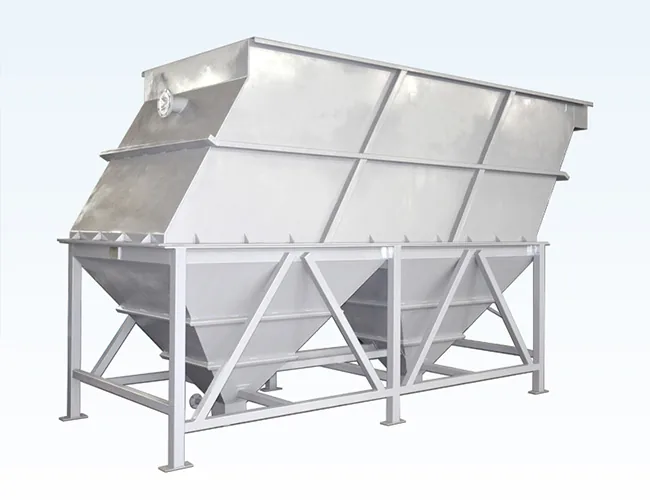
Settled solids separated from water — inclined tube and plate settlers for compact clarification, and peripheral-drive scrapers for large circular tanks.
What a sedimentation stage is, and what the site still does
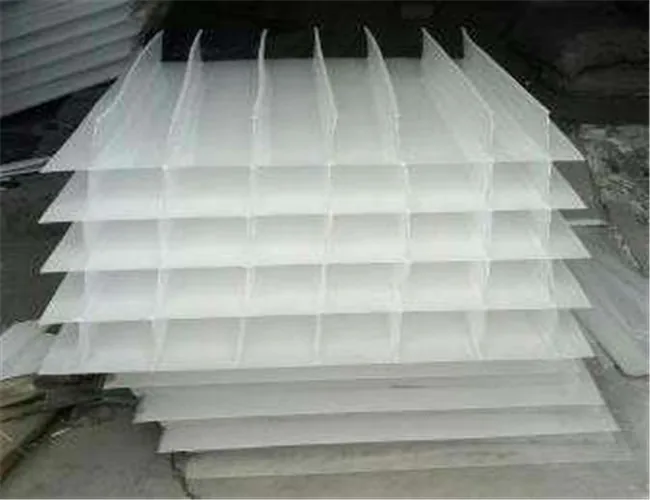
Sedimentation separates solids from water under gravity. A clarifier gives the floc a still volume in which to settle; the clarified water leaves from the top and the settled sludge is collected at the bottom. The family has two working forms. Inclined tube and plate packs add settling area inside a tank, so the same clarification is reached in a smaller footprint, and the sludge slides down the inclined surfaces into a hopper. A peripheral-drive scraper travels around a large circular tank and drives the settled sludge to the centre outlet, with the clarified water drawn off at the rim. The equipment is assembled and tested at our factory before shipment, so on site the civil tank and its foundation, the inlet and outlet pipework to our flanges, the power cable, and the lifting and placement are site work.
The process removes solids that settle. This page is not a claim that it removes dissolved organic matter, ammonia, phosphorus or salts; those loads belong to a biological or chemical stage. It is also not a dewatering step: the sludge that leaves the clarifier still has to be thickened or dewatered and sent to a legal outlet. Plate settlers are also described as lamella plates, and the inclined-tube and inclined-plate forms share the same shallow-channel principle.
When the solids are light, oily or slow to settle, dissolved air flotation can be the better separation stage. When rags, grit or fibre are the problem, screens and filtration belong ahead of the clarifier. The sludge side is covered by the sludge dewatering range.
Inclined tube or plate settler, or peripheral-drive scraper?
The choice follows the tank and the duty. An inclined settler suits a compact clarification or tertiary polishing duty, a new package unit, or an existing basin that has to do more settling in the same plan area. A peripheral-drive scraper suits a large circular tank where the floor area and the sludge volume are both large and the floor has to be kept clear continuously. The two forms are not interchangeable: the inclined settler adds surface inside the tank, the scraper moves the sludge across the floor of a tank whose area is already fixed.
- Inclined tube or plate settler — compact clarification, tertiary polishing after a biological stage, and retrofit of an existing basin. The inclined tube settler detail page carries the media, surface-loading and hopper details.
- Peripheral-drive sludge scraper — large circular primary or secondary clarifiers, where the bridge and drive keep the floor clear. The sludge scraper detail page carries the drive, tank-diameter and bridge details.
- Another stage — light oil or slow solids point to flotation, dissolved matter points to biology, and a final polish points to filtration.
The selection and sizing guide takes the choice from the duty rather than from the product name. The design influent quality chart is the place to start when the feed is not yet characterised.
The data a sedimentation design needs
Design flow alone does not size a clarifier. The design needs the average and peak flow, the suspended-solids concentration, the floc size and settling behaviour, the required surface loading, and the temperature that affects both viscosity and settling. For a scraper it also needs the tank diameter and side depth, the sludge load on the floor, and the bridge span. For an inclined settler it needs the plan area available and the media arrangement.
The influent matters as much as the flow. A stream that carries oil, fibre or grit has to be pre-treated before either form works as intended. The design influent quality chart sets out the parameters to bring to a sizing discussion.
Hydraulic retention time, tank volume and short-circuiting
Hydraulic retention time is tank volume divided by flow. It matters for floc formation and for the sludge, but it is not the criterion that fixes the settling area: the area is fixed by the surface loading the duty needs. A tank can have a long retention time and still short-circuit if the inlet jet crosses the tank, if density currents run along the floor, or if the outlet weir pulls water unevenly. Inlet distribution, baffles and a level weir are what protect the settling volume. The result rests on the settling area, the surface loading and the sludge handling behind it, not on tank volume alone.
The tank volume and HRT chart turns a required retention time into a basin volume, and the tank volume and HRT calculator works the same calculation for a given flow. Those are volume checks on the same tank; the settling area remains a separate calculation.
The settling-area basis, and a worked overflow-rate check
Surface loading, or overflow rate, is the flow divided by the plan area of the settling tank: m³/h divided by m² gives m³/m²·h. The CXKG table lets that be checked. Across the six published models the overflow rate on the tank plan area is about 2.7–3.4 m³/m²·h.
Worked through on two models: CXKG-10 is 10 m³/h over a plan area of 2.5 × 1.5 = 3.75 m², so 10 ÷ 3.75 = 2.67 m³/m²·h. CXKG-100 is 100 m³/h over 12.0 × 2.5 = 30 m², so 100 ÷ 30 = 3.33 m³/m²·h. The pack inside the tank adds effective settling surface beyond the plan area; that media area is set at design from the solids and is not the same number as the plan-area overflow rate.
What the check does and does not say
The plan-area overflow rate is a derived check on the published catalogue table, not a promised duty for your stream. The operating surface loading, the media area and the sludge withdrawal rate are confirmed at sizing from the flow, the solids and the settling test. The surface loading and hydraulic loading article sets out the unit and the assumptions.
Sludge collection, withdrawal and the outlet
Sludge withdrawal is part of the clarifier, not an afterthought. In an inclined settler the solids slide into a hopper and are drawn off from it; in a peripheral-drive scraper the blades drive the floor sludge to a collection tank and the discharge device empties it. The concentration that can be drawn, the volume produced and the pumping arrangement depend on the feed solids and the process, and they are confirmed for the project.
The sludge still needs a downstream route. Thickening or dewatering and the legal outlet are a separate stage, and the sludge dewatering range takes it on to a handleable cake. The disposal route follows the local rule and the waste classification rather than a generic statement.
Supply, civil interface and site scope
In our supply sits the clarification equipment itself. For an inclined settler that is the tank with its media packs, hopper and sludge discharge; for a scraper it is the bridge, the drive units, the scraper arms, the sludge collection tank and the electrical equipment. The civil tank, its floor and walls, the foundation, the inlet and outlet pipework to our flanges, the power cable, and the lifting and placement on site are site work. We are not a turnkey civil contractor.
- Confirmed per order — the tank or bridge dimensions, the media or scraper arrangement, the discharge detail and the interface drawing.
- Site work — the concrete tank and its watertightness, the foundation and anchorage, the pipework to the unit flanges, the electrical supply and the lifting plan.
- Transport — the transport envelope is confirmed with each order against the packed dimensions, the route and the port of discharge.
The selection and sizing guide takes the site conditions into the choice before the equipment is fixed.
Acceptance is written into the contract: factory acceptance tests before shipment, site acceptance tests after installation, and a performance test on the suspended solids and turbidity of the clarified overflow at design load, with the sampling point, the test method and the receiving works' standard fixed for the project, the party that carries a missed result named, and a failed result rectified and retested as agreed. Acceptance records are project documents: the catalogue values on this page are references, not guarantees, and when you compare quotations, ask for the acceptance section of the contract.
One source for the CXKG and CXZB tables
The CXKG and CXZB model tables on this page come from the same brochure table as the two detail pages, so the hub and the detail page cannot quote different numbers for the same model. Dimensions and weights are reference values reproduced from the catalogue and are approximate; final values are confirmed against the site conditions and the actual build.
What the brochure does not publish is project data: the media angle and spacing, the drive torque, the bridge load and any first-party performance test. Those are confirmed for the project and are not presented here as a catalogue guarantee. The two detail pages carry the same table and the project-confirmation boundary for their own equipment.
CXKG inclined tube/plate settler
The CXKG is a consolidated inclined tube or plate settler: the tank, the media packs, the hopper and the sludge discharge are built as one item and shipped as a unit. Raw water enters at the inlet and is distributed across the media; the solids settle onto the inclined surfaces and slide into the sludge hopper, while the clarified water is drawn off at the top. The unit can be used on its own as a clarification stage, or as the tertiary stage that polishes the effluent of a biological train before discharge. Tank material, media grade and the inlet arrangement are chosen against the water being treated and the site conditions.
| Model | Capacity (m³/h) | Volume (m³) | Dimensions L × W × H (mm) | Weight (t) |
|---|---|---|---|---|
| CXKG-10 | 10 | 7.5 | 2500 × 1500 × 2500 | 1 |
| CXKG-20 | 20 | 15 | 5000 × 1500 × 2500 | 2 |
| CXKG-40 | 40 | 30 | 6500 × 2000 × 2500 | 3.2 |
| CXKG-50 | 50 | 37.5 | 8000 × 2200 × 2500 | 4.5 |
| CXKG-80 | 80 | 60 | 9500 × 2500 × 2750 | 5.2 |
| CXKG-100 | 100 | 75 | 12000 × 2500 × 2750 | 6 |
This is the same six-model CXKG table as the inclined tube settler detail page. Dimensions and weights are reference values reproduced from our 2026.6 catalogue and are approximate. Final dimensions and weights are confirmed against the site conditions and the actual build.
CXZB peripheral-drive sludge scraper
The peripheral-drive sludge scraper is mainly composed of the bridge, the cut-off walls, the transmission system, the water tank, the sludge collection tank, the sludge discharge device and the electrical device. Water to be treated enters the tank through central pipes and then flows to the sedimentation basin; clean water at the upper layer is discharged directly, while sludge at the bottom is pumped to the collection tank and finally discharged. The bridge is built as a truss, the components that contact the water are made in stainless steel, and the scraper bridge can be customised on request.
| Model | Tank diameter (m) | Tank side depth (m) | Peripheral speed (m/min) | Motor power (kW) |
|---|---|---|---|---|
| CXZB-20 | 20 | 3–5.6 | 1.6 | 0.37 × 2 |
| CXZB-30 | 30 | 3–5.6 | 1.8 | 0.55 × 2 |
| CXZB-45 | 45 | 3–5.6 | 2.2 | 0.75 × 2 |
| CXZB-55 | 55 | 3–5.6 | 2.4 | 0.75 × 2 |
| CXZB-60 | 60 | 3–5.6 | 2.6 | 1.5 × 2 |
| CXZB-100 | 100 | 3–5.6 | 2.8 | 2.2 × 2 |
This is the same six-model CXZB table as the peripheral-drive sludge scraper detail page. Dimensions are reference values reproduced from our 2026.6 catalogue and are approximate. Final dimensions and weights are confirmed against the site conditions and the actual build.