
Wastewater screening and microfiltration.
Coarse and fine solids removed ahead of the process train: bar screens at the inlet, rotary drum screens, microfilters for polishing and mechanical filters after settling, each sized to your flow.
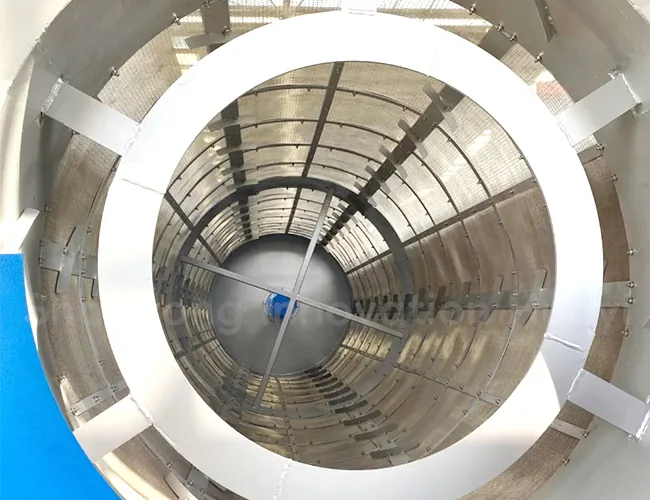
What screening and filtration is, and what the site still does
Screening and filtration covers the duties that take solids out of the flow at the front of a treatment train and the duties that polish it behind the process: a bar screen rakes large matter out of a channel, a rotary drum screen carries the flow through a perforated drum, a microfilter polishes a flow that has already been treated, and a mechanical filter holds fine solids in a media bed after settling. The four duties are not interchangeable, and the first question is which one your site actually has. The screen is assembled and tested at our factory before shipment, and the site interface and the commissioning plan are agreed before delivery; on site the channel or chamber and its civil works, the pipework to our flanges, the power supply and earthing, the wash-water supply, the lifting and placement, and the screenings route away from the unit are site work.
Which screening duty first: bar screen, drum, microfilter or mechanical filter?
Screening is not one product. Four duties are often confused at the front of a train: a bar screen that rakes large matter out of a channel, a rotary drum screen that carries the flow through a perforated drum, a microfilter that polishes a flow already treated, and a mechanical filter that holds fine solids in a media bed. The first question is which duty your site actually has, not which model is cheapest. The selection and sizing guide takes the flow and the discharge standard through the same decision.
Wide table: scroll sideways to see every column.
| Device type | Where it is used | Boundary to confirm | Detail page |
|---|---|---|---|
| Bar screen, rotary rake | Inlet channel or pump station; the rake teeth comb the bars and lift debris clear | Bar spacing, channel width and the screenings discharge are fixed per project | View detail |
| Bar screen, internal feed | Headworks fine screening; the flow is fed inside the mesh belt and washed out | Aperture, channel or chamber dimensions and wash water are fixed per project | View detail |
| Rotary drum screen | Small and medium inlets; the drum spans the channel and a wash bar cleans it | Drum diameter, aperture and wash demand are fixed per project | View detail |
| Rotary microfilter | Polishing after treatment, ahead of reuse or discharge | Mesh opening and drum size are fixed per project; the removal figure belongs to the detail page | View detail |
| Mechanical filter | After settling; a pressure vessel with a graded media bed and backwash | Vessel size, media grading and backwash are fixed per project | View detail |
Four screening duties and the detail page that carries each model range. The boundary is confirmed at sizing; this table is a starting point, not a catalogue rule.
Each duty has its own page: the rotary rake screen, the internal feed screen, the rotary drum screen, the rotary microfilter and the mechanical filter. This hub does not repeat their model tables: the model range, mesh opening, drum diameter and capacity for each are on the detail page for that duty.
The decision starts from the duty, not the model
The four types cannot be separated by one number. A bar screen and a drum screen both take coarse material, but one rakes it out of a channel and the other carries it round a drum. A microfilter and a mechanical filter both polish, but one is a fine screen and the other is a media bed. Where the duty is not clear from the flow and the site, it needs project confirmation rather than a catalogue rule.
What bar spacing or mesh opening can be claimed, and what cannot be guaranteed
Bar spacing or mesh opening is the number that decides what is retained. It is a clear opening, not a particle size: a screen retains the material that cannot pass the opening, and the shape of the material decides whether a particle of a given size passes. The aperture is chosen from what has to be protected downstream — a pump station, a grit chamber, a membrane or a discharge.
We do not publish a universal removal rate for this family. Removal is a test result on your flow, at an agreed sampling point, and it depends on the aperture, the solids, the flow and the washing. A removal figure for the CXWL rotary microfilter series belongs to its own detail page and to the condition stated there; it is not restated here as a guarantee for another duty.
No removal guarantee on this page
This page states the boundary, not a performance guarantee: a screen is selected for an aperture and a duty, and the removal is proved on the project water.
The data a screen design needs: peak flow, solids, fibre, grease and the channel
The peak flow, not the average, is what a screen is checked against. A screen sized on the daily mean blinds or floods at the peak, and a screen sized only on the peak wastes channel width at the low flow that follows. Capacity is not a single number either: the flow a screen handles is fixed by the channel width, the water depth and the aperture, and it is confirmed at sizing.
The design also needs the suspended solids, the fibre and rag load, the grease, and the channel or chamber dimensions and water depth. The sewer type changes the answer more than a table does: a separate sewer carrying domestic flow is a different duty from a combined sewer carrying road sand and construction debris, and an industrial inlet carrying process fibre is different again. The design influent quality chart is the place to start when the feed has not been characterised.
Grit is a separate duty from screening and sits behind it. Grit removal in wastewater treatment covers the settling side of the headworks and how a chamber is sized for the grit load.
Head loss, blinding and the interface with the channel
Head loss through a clean screen is not the design case. A clean bar screen costs little head, but a blinded screen, or one carrying a peak rag load, costs much more, and the channel has to have the freeboard and the upstream level to keep the flow moving. The head loss a screen can take is therefore a design input, not a catalogue footnote.
The same channel carries the screen, the grit chamber and the flow measurement, and a change to one moves the others. The screen has to fit the channel width and depth, the approach velocity has to keep solids moving to the screen without carrying them through, and the discharge has to clear the water line. Where the inlet is a chamber rather than a channel, the unit is arranged differently and the interface is fixed for the project.
Screenings: how much, how they are dewatered, and who owns the outlet
The screenings quantity follows from the aperture and what the sewer carries, and it is not a fixed percentage of the flow. A coarse bar screen takes less material by mass than a fine screen, but the material it takes is bulkier; a fine screen takes more, and the material is wetter. The volume to handle is therefore confirmed from the site and the duty rather than from a universal figure.
The screenings have to leave the screen, be dewatered or drained, be conveyed to a container or skip, and be disposed of lawfully. In our supply sits the screen and the discharge arrangement for the unit; the conveyor, the skip, the wash water and the transport are fixed with the order. The legal outlet for the screenings is a project matter, set by the local rule and the receiving facility, and the operator carries the generator responsibility.
Materials: stainless steel, and where the grade is decided
We build the wetted parts in stainless steel. The grade is chosen against the water, and we confirm it for the project: a standard austenitic grade for ordinary municipal and industrial duty, and a higher grade where the chloride load, the seawater or the process chemistry calls for it. The choice is not a universal rule, because a grade that serves a municipal inlet can pit in a chloride-rich industrial flow.
The drive, the bearings and the wear parts are selected with the same question: what the flow carries and what the site can maintain. A screen in a coastal or saline duty needs the grade and the wash arrangement confirmed for the project rather than assumed from a standard table.
What is in our supply and what stays on site
In our supply sits the screen body, the screen surface (bars, mesh panels or drum), the drive, the wash system where the type has one, the discharge arrangement for the unit, and the control panel that runs it. The exact split is written into the commercial offer for the project.
On site sit the channel or chamber and its civil works, the upstream and downstream pipework to our flanges, the power supply and earthing, the wash water supply where it is not part of the packaged scope, the lifting and placement, and the screenings route away from the unit. The screen is assembled and tested at our factory before shipment; the site interface and the commissioning plan are agreed before delivery.
The boundary matters because a screen is not a complete headworks package. The civil structure, the grit chamber and the flow measurement are separate scopes, and the interface drawing is what fixes them. The plant selection and sizing guide takes the site conditions into the choice before the equipment is fixed.
Acceptance is written into the contract: factory acceptance tests before shipment, site acceptance tests after installation, and a performance test on the retention at the design flow, with the aperture or bar spacing, the solids load, the wash-water flow and the screenings route agreed for the project, the sampling point, the sample handling and the test method named, the party that carries a missed result named, and a failed result rectified and retested as agreed. Acceptance records are project documents; when you compare quotations, ask for the acceptance section of the contract.
Operation, spares and the documents behind the figures
A bar screen rakes on a cycle set by the flow and the load; a drum or a microfilter turns continuously and washes its surface. The routine work is the check that the screen is clean, the wash water is flowing, the discharge is clear and the drive is not overloaded. The control panel runs the sequence, and the alarm and shutdown logic is fixed for the project.
We hand over an operation and maintenance manual and operator training with the unit, and the manual is written for the project. Spares follow the wear parts: the rake teeth, the screen panels or drum mesh, the wash nozzles and the drive components. The recommended spares list and the response route are confirmed with the order.
The drawings, the manual and the project test records are issued for the project. We do not publish a third-party removal test report for this family because none is on file; where a project needs one, it is run on the commissioned unit and recorded. The dissolved air flotation and sedimentation ranges cover the separation stages behind the headworks, and the integrated site package is where the headworks is bought together with the rest of the train.