
Sludge dewatering equipment.
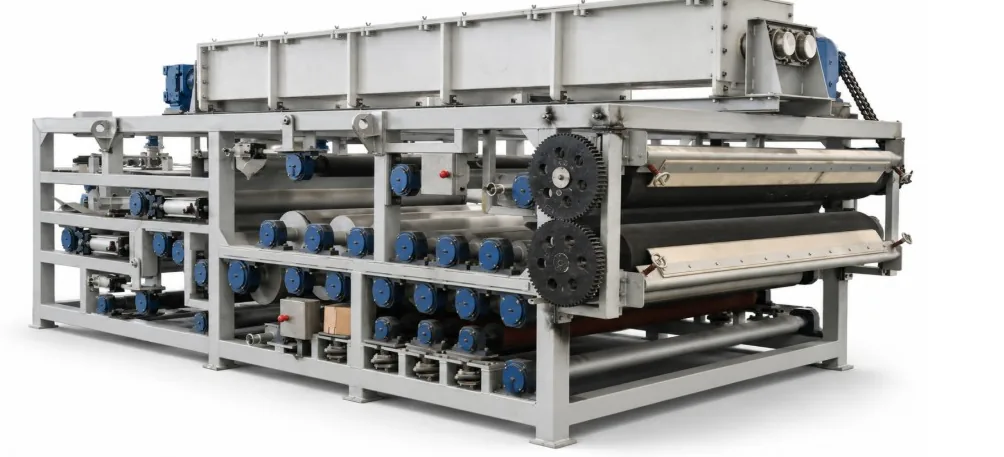
Screw press, belt press, plate-and-frame and vacuum belt units that take the sludge out of a treatment train to a handleable cake, supplied as complete units and sized to your sludge volume.
What sludge dewatering is, and what the site still does
Sludge dewatering is the stage that takes the liquid sludge produced by a treatment train and removes water until the solids form a cake that can be transported and disposed of. Four machine families cover the usual duties: a screw press dewaters continuously at low speed with the whole duty factory-mounted on one skid; a belt filter press passes the sludge through gravity drainage and then a series of pressure zones, which suits larger volumes; a plate-and-frame press forms a filter cake in closed chambers under pressure where a high dry-solids content is the objective; and a vacuum belt filter forms the cake on a moving cloth and draws the filtrate through it by vacuum, for fine slurries and duties where the cake also has to be washed. The machine is assembled and tested at our factory before shipment, and the ancillaries named in the offer are supplied with it; on site the foundation and anchorage, the civil structure and bund, the feed and discharge pipework to our flanges, the power cable, the water and chemical supply, and the lifting and placement are site work.
Which sludge dewatering machine first: sludge type, volume and cake target
The first decision is not the model but the family. Four families do the same job in different ways, and the feed decides which one is being asked to do too much. The matrix below narrows the choice to a family; the model, the belt or drum width and the polymer dose are then fixed during sizing against your sludge.
Wide table: scroll sideways to see every column.
| Sludge or duty | Throughput band (published basis) | Cake objective | First machine to look at |
|---|---|---|---|
| Waste activated or mixed municipal sludge, small to medium duty, thin operator cover | 6–480 kgDS/h (CXDL catalogue range) | A handleable cake on a continuous duty | CXDL screw press |
| Municipal or industrial sludge, medium to large, continuous run with wash water available | 3–12 m³/h feed at 8–12% feed solids (CXSW catalogue) | 30–40% cake solids at that feed (CXSW catalogue range) | CXSW belt filter press |
| Mineral, granular or difficult sludge, or a duty where the cake has to be as dry as the sludge allows and labour is available | Batch: chamber volume and plate count fixed for the project | As dry as the sludge allows; set by a test, no published figure | CXBK plate-and-frame press |
| Fine slurry where the cake has to be washed, or a soluble component recovered | 1–25 m² filter area and 630–1700 mm belt (CXDU catalogue) | A washed cake; residual moisture set by a test | CXDU vacuum belt filter |
A first-machine matrix. The bands are the published catalogue ranges of each family; the model is fixed on your sludge during sizing.
Read the matrix as a starting point, not a selection. Each family page carries the model table and the utility figures that belong to that machine; this hub does not repeat them.
- CXDL screw press — continuous, low speed, low wash water, one skid. The screw press detail page carries the 6–480 kgDS/h model table, power and wash water. Not the first choice where the feed is gritty or fibrous without screening ahead, or where a much drier cake is the only objective.
- CXSW belt filter press — gravity drainage, then wedge and roller pressure, for larger continuous duties. The belt filter press detail page carries the belt widths, the capacities and the 8–12% feed to 30–40% cake note. Not the first choice for a duty that runs a few hours a day.
- CXBK plate-and-frame press — batch filtration in closed chambers, chosen for cake dryness. The plate-and-frame detail page explains how the plate count and the chamber depth are fixed. Not the first choice where labour for the batch cycle is not available.
- CXDU vacuum belt filter — continuous vacuum filtration with cake washing. The vacuum belt filter detail page carries the belt, filter-area and motor table. Not the first choice where nobody can maintain a vacuum pump and a cloth.
Two checks close the choice. A dewatering test on the actual sludge, because one family can behave differently on two sludges of the same name; and the utility balance over a plant life, because a machine that uses less power, wash water and polymer can be cheaper in the long run. The sludge dewatering machine comparison article sets out the comparison, the sludge dewatering selection guide works the sludge type, volume and cake target through the options in order, and the selection and sizing guide takes the site conditions into the choice.
If the feed is thin, a thickening stage ahead of the machine changes the size of the machine and the polymer demand. The sludge thickening article covers gravity, flotation and drum thickening.
The data a dewatering design needs
Design flow alone does not size a dewatering unit. The design needs the sludge type — primary, waste activated, mixed, chemical or mineral — the feed solids concentration, the daily dry-solids production, the organic or inorganic character, and whether the feed carries fibre, grease or grit. It needs the peak and the batch pattern too: a unit sized on an average flow still has to hold the peak without losing the cake.
Capacity is a dry-solids duty, not a volume. A machine is sized in kilogrammes of dry solids per hour or per day, because two sludges at the same flow can carry very different solids loads. Ask for the capacity to be stated on your sludge, at your feed solids, with the polymer dose it assumes.
Fibre, grease and grit change the machine. Fibre blinds a cloth and wraps a screw; grease blinds a belt; grit wears a screw, a screen and a cloth. Screening, grit removal and grease capture ahead of the machine are cheaper than a rebuild, and they belong in the enquiry. The screens and filtration range covers the upstream step, and the design influent quality chart lists the parameters to bring to a sizing discussion.
Where the feed comes from a clarifier, the way the sludge is drawn and thickened upstream changes both the volume and the consistency the machine sees. The sedimentation and clarification range covers that stage.
Polymer, wash water and what drives the running cost
All four families condition the sludge with polymer, and the dose is set by a test on the actual sludge — a jar test for a filter press, a bench flotation test where flotation is involved. We do not publish a single PAM consumption figure, because the dose moves with the sludge, the feed solids and the season; a number quoted without the sludge is not a specification.
Wash water is the second consumable. A belt press washes its belts continuously; a vacuum belt filter washes its cloth and, where fitted, the cake; a screw press uses much less, and the CXDL table publishes wash water per model on the screw press detail page. The wash water and the filtrate leave the machine together and return to the head of the works or to the plant drain; they are not clean water.
Power and wear parts complete the running cost. The slow screw and the low wash-water demand are why a screw press suits a lightly attended plant; the higher pressure of a plate-and-frame press buys dryness at the cost of a batch cycle, cloth and labour. Compare the utility balance over a plant life, not the purchase price alone.
What is in our supply, and what stays on site
In our supply sits the dewatering machine and the ancillaries named in the offer for that family. A screw press is supplied as a skid with the sludge pump, the wash-water pump, the polymer dosing system and the control panel mounted, piped and wired. A belt press, a plate-and-frame press and a vacuum belt filter are supplied as machines, with the ancillary equipment listed in the offer for the duty.
- In our supply — the dewatering machine and the ancillaries named in the offer: pumps, polymer unit, control panel, skid or frame, and the discharge arrangements listed for the family.
- Site work — the foundation and anchorage, the civil structure and bund, the feed and discharge pipework to our flanges, the power supply and cable, the water and chemical supply, and the lifting and placement on site.
- Confirmed per order — the machine size, the skid or frame layout, the interface drawing, the utility schedule and the transport envelope.
The selection and sizing guide takes the site conditions and the utility schedule into the choice before the equipment is fixed. Where the duty is a complete plant rather than a machine, the integrated site package covers the wider scope.
Acceptance is written into the contract: factory acceptance tests before shipment, site acceptance tests after installation, and a performance test on the dry-solids content of the cake and the solids carried in the filtrate at the design feed, with the sampling point, the sample handling, the dry-solids and filtrate-solids methods, the feed solids at the time of the test and the polymer dose agreed for the project, the party that carries a missed result named, and a failed result rectified and retested as agreed. A result quoted without those conditions cannot be compared with another supplier. Acceptance records are project documents; when you compare quotations, ask for the acceptance section of the contract. The catalogue values on this page are references, not guarantees.
Operation, training and the real limit of unattended running
The CXDL screw press catalogue states one-push-button start and stop and automatic shutdown, and that is what the machine can do. Unattended here means the press does not need an operator standing at it during a steady run; it does not mean an unmanned plant. The unit still needs a defined operator round for polymer make-up, wash water, cake discharge and alarms, and the alarm and shutdown logic is fixed for the project.
Handover covers the operating sequence, the polymer preparation, the wash-water and filtrate arrangement, the routine checks and the spare-parts list. The checks that matter are the dose, the screen or cloth condition, the belt tracking on a belt press, and the vacuum seal on a vacuum belt filter. Training is given at commissioning, and the manual is the reference afterwards.
What we do not promise is that a unit runs without attention because the brochure says unattended. The operating plan, the alarm set-points and the response time belong in the contract.
Cake, filtrate and wash water: where each one goes
The machine produces two streams. The cake leaves as the product and goes to the disposal or reuse route the project has arranged; the filtrate and the wash water carry the solids the machine did not capture and return to the head of the works, to an equalisation tank or to the plant drain.
The legal outlet is a project matter, not a machine setting. The waste classification, the receiving site, the transport and the permit are decided by the operator and the local authority; we supply the machine and the performance data, and we do not take over the disposal route.
The return load is real: fines, ammonia and phosphorus come back with the filtrate, and the biological stage sees them. A design that counts only the raw influent will be short of capacity. The sludge moisture content and disposal cost article sets out how cake moisture moves the mass and the haulage.
The documents and project evidence behind these numbers
The model tables on the detail pages come from our June 2026 catalogues. The figures in the matrix on this page are taken from those same tables. Dimensions, weights, power, wash water and dry-solids throughput are reference values reproduced from the catalogues; final values are confirmed against the site conditions and the actual build.
There is no universal cake-dryness guarantee, and a page that offers one is hiding the variables. Cake dryness follows the sludge type, the feed solids, the polymer dose, the machine settings and the time under pressure; the same machine gives a different cake on two sludges with the same name. The only cake range published for this equipment is the belt press note of 30–40% cake solids at 8–12% feed solids, and that is a catalogue range for that family, not a promise for your sludge.
What the catalogues do not publish is project data: the cake dryness and filtrate result on your sludge, the polymer dose, the vacuum or pressure settings and the cycle time. Those are confirmed by a test on the sludge and by the sizing, and they are not presented here as a guarantee.
Project records are on the case references page: the municipal and industrial projects listed there name the equipment and the moisture levels that were documented, and each entry states what was recorded. The comparison article and the selection guide carry the method behind the matrix.