
On this page
PTAR is the Spanish acronym for planta de tratamiento de aguas residuales — a wastewater treatment plant. The term is the one used in Mexico, Colombia, Peru, Chile, Ecuador and Argentina in tenders, permits and operating contracts, and it covers every scale, from a rural unit serving a few dozen people to a municipal works serving a city.
The English equivalent is simply wastewater treatment plant. What the acronym does not say is the part that decides the project: which standard the effluent has to meet and what the incoming water contains. Two plants with the same name can differ in flow and in every parameter of the design.
PTAR is not PTAP
PTAP stands for planta de tratamiento de agua potable — a drinking water plant. The two are confused in conversation and sometimes in a bid package. A PTAP train is built to remove turbidity, colour and pathogens from raw water: coagulation, flocculation, settling, filtration and disinfection. A PTAR is built to remove the organic load, the solids and the nutrients that wastewater carries. A PTAP cannot meet a BOD or ammonia limit, and a PTAR is not a drinking water treatment chain.
The name also changes by country. In Spain the same works is called EDAR, estación depuradora de aguas residuales, and some Andean documents use planta de tratamiento de aguas servidas. The function is the same; the paperwork is not.
The train behind the acronym
Almost every PTAR, at any scale, is assembled from the same five duties in the same order. What changes is how each duty is carried out and how much of it there is.
Pre-treatment
Screening removes rags, plastics and coarse solids; grit removal takes the sand and gravel that would wear out pumps; a grease trap or a flotation step takes fats, oils and grease; equalization absorbs the difference between what arrives and what the biology can accept. The purpose of the whole stage is not treatment but protection: it hands the next stage a flow and a composition it can work with.
Primary treatment
Settling removes the solids that fall out on their own. In a municipal plant that is a primary clarifier; in an industrial plant with light suspended solids it may be dissolved air flotation instead. Either way the stage reduces the load the biological step has to carry, and produces a sludge stream that has to be handled.
Biological treatment
This is the stage the plant is named for in practice. Aerobic processes — activated sludge, extended aeration, MBBR, SBR — use a bacterial population to oxidise the organic matter and, with the right alternation of aerated and unaerated zones, to remove nitrogen and phosphorus as well. Anaerobic processes are used where the organic load is high and concentrated, because they produce biogas instead of consuming air.
Disinfection
Chlorination, UV or ozone, chosen by the coliform limit and by what happens to the water afterwards. Chlorine leaves a residual that protects the water in the pipe but forms by-products with organic matter; UV leaves nothing but needs clear water ahead of it. Where the effluent is reused for irrigation, the disinfection target is set by the reuse standard, not by the discharge standard.
Sludge
Every biological plant produces sludge, and sludge is where budgets most often break. Thickening reduces the volume, dewatering turns it into a cake that can be transported, and the cake still has to go somewhere. A PTAR quoted without a sludge line is an incomplete quotation, not a cheaper one.
What fixes the size of each stage
Wide table: scroll sideways to see every column.
| Parameter | What it sizes | Read it from |
|---|---|---|
| Flow and peak factor | Equalization, pumps, clarifier area, disinfection contact | The site flow record or the design brief, not a per-capita table on its own |
| BOD5 and COD | Aeration volume, oxygen demand, sludge production | The influent analysis, or the ratio between them where only one is measured |
| Suspended solids | Screening, primary settling, sludge handling | The influent analysis |
| Nitrogen and phosphorus | Aerobic and anoxic zoning, sludge age, chemical dosing | The discharge standard and the influent analysis together |
| Coliforms | Disinfection dose or UV transmittance | The discharge or reuse standard |
Each row is read from a measurement, not from a table of typical values.
Four ways a PTAR gets built
Wide table: scroll sideways to see every column.
| Format | What it suits | What decides it |
|---|---|---|
| Civil works | Large municipal plants, long service life, land available | The capital available and the construction programme the client can run |
| Packaged or skid unit | Small and medium plants, fast installation | Factory assembly against site work; lifting and road access |
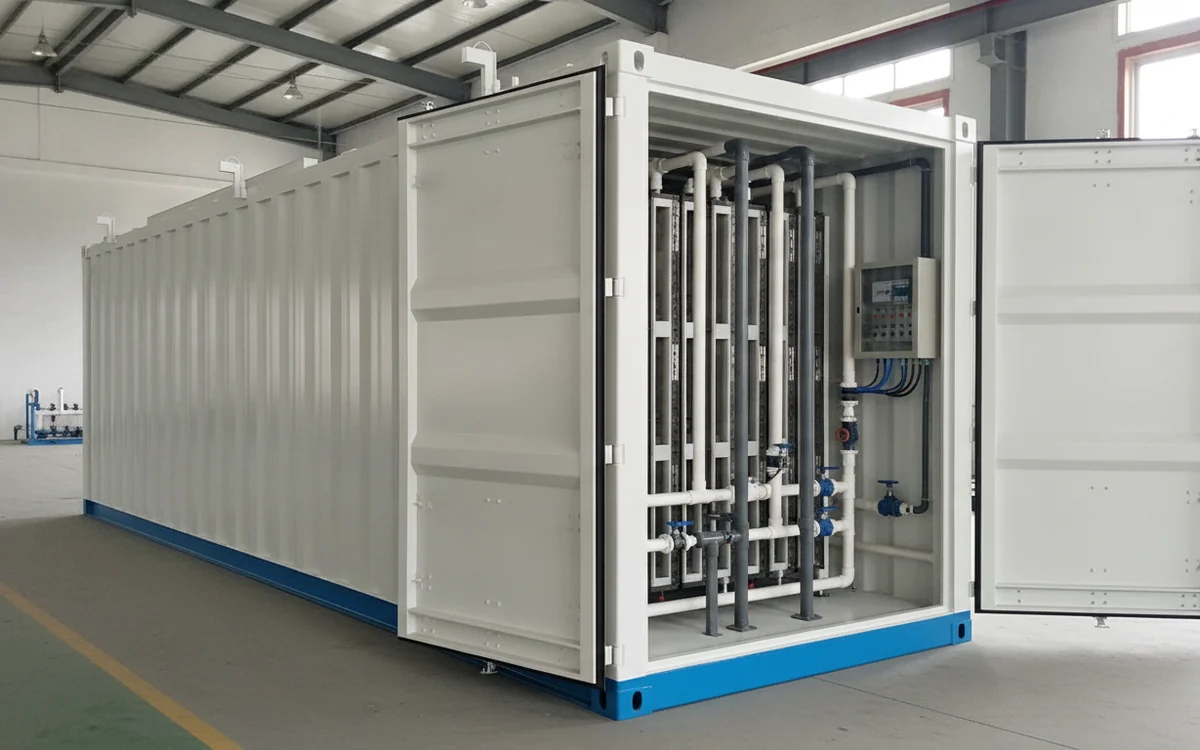
| Containerized | Remote sites, island and camp projects, relocation | The transport route and the ISO container as the shipping unit |
| MBR | Reuse, a tight footprint, a strict solids limit | The effluent target and the cost of membrane replacement over the life |
The format is a delivery decision; the process train inside it does not change.
The standard decides more than the flow
Colombia is a clear example. Resolución 0631 de 2015 sets municipal limits by the size of the plant and industrial limits from a separate table. For a municipal plant, the Article 8 column for a load up to 625 kg/day of BOD5 allows COD 180, BOD5 90, TSS 90 and settleable solids 5.00. The Article 15 table, which applies to industry, allows COD 150, BOD5 50, TSS 50 and settleable solids 1.00.
The same acronym covers both. A plant built to the first table and then judged against the second sees its permitted BOD5 fall from 90 to 50, and the only thing that changed was which table the authority applied.
That is why the standard is read before the process is chosen, not after the drawings are finished. Our page on Resolución 0631 de 2015 walks through the tables, the thresholds between them and the sewer factor.
What a quotation needs before it means anything
- Design flow, average and peak, with the record it comes from
- Influent analysis: BOD5, COD, suspended solids, nitrogen, phosphorus, pH, and any parameter specific to the industry
- The discharge or reuse standard, with the article or table number where one exists
- Power supply: voltage, frequency, phases, and whether it is grid or generator
- Site conditions: temperature range, altitude, road access, lifting capacity
- Sludge route: who takes the cake, and at what moisture it has to leave
A quotation assembled without these is a price for a shape, not for a plant.
Where a PTAR fails
Most failures are not in the biology. They are in the equalization volume, sized for the average flow and not for the shift pattern; in the sludge line, left to the operator; or in the assumption that the standard in force at design would still be the standard at start-up.
The second common failure is scale. A plant sized for the design population and not for the load the connected industries add is a plant that works on paper and not in the rainy season.
What determines the cost of a PTAR
There is no price list that holds for every project: plants treating the same flow can have very different costs depending on what the water carries and the standard it has to meet. These are the factors that move a quotation, in the order in which they usually move it.
- Flow rate and discharge pattern — a continuous average flow is not the same as a shift that discharges in two hours; the equalisation volume and the peak factor change with the pattern.
- Pollutant load — BOD, COD, solids, nitrogen, oils and metals set the size of the biology and whether chemical pretreatment is needed.
- Discharge standard — the same flow under a stricter limit requires more volume, more air or an additional stage; the standard is the first input to the quotation.
- Process train — conventional biology, MBBR or MBR change the equipment, the operation and the energy consumption.
- Materials and corrosion — carbon steel, FRP or stainless steel are chosen for the aggressiveness of the water, not by preference.
- Sludge line — thickening, dewatering and the fate of the cake are usually the part that is cut most and the part that fails most later.
- Civil works and site — a containerised plant and a concrete plant do not compete on the same plot or with the same schedule.
- Energy and operation — the cost of operating does not appear in the equipment quotation, but it decides the total cost of the project.
A quotation that does not say what flow, what standard, what load and what scope of supply it assumes is a price for a shape, not for a plant.
How to evaluate a PTAR supplier
The questions that separate a manufacturer from a reseller are the same for any supplier. It is worth putting them to every bidder and comparing the answers, not the presentations.
- Written process basis — what flow, what load and what standard were used for sizing, and what happens if the actual analysis differs.
- Scope limits — what is delivered, what remains with their contractor and who connects what.
- Verifiable references — plants comparable in flow and water type, with permission to contact.
- Factory test — what is tested before shipment and with what acceptance criterion.
- Commissioning — who carries it out, how long it lasts and what operator training includes.
- Documentation — drawings, manuals, spare-parts list and the test record.
- Spare parts and response — which critical spares are recommended and what the stated response time is.
- Warranty and limits — what it covers, what it does not cover and which site conditions void it.
The supplier who answers these questions in writing is usually the one who can also sustain the plant after start-up.
Frequently asked
Is a PTAR the same as a wastewater treatment plant? Yes: the acronym and the long name designate the same works. The difference is language and jurisdiction, not process.
What is a PTAR used for? To treat the wastewater from a municipality, a development, a hospital, a hotel or an industrial plant before it goes to a water body, a sewer or a reuse system.
How big is a PTAR? A containerized unit we build treats between 0.5 and 10 m³/h, and a municipal plant is a multiple of that in civil works. The number of units follows the flow and the peak factor, not the other way round.
How much does a PTAR cost? There is no published price list, because the same flow can require a different aeration volume, different materials against corrosion and a different sludge line. The quotation is built from the flow, the influent analysis and the standard, and it is quoted per project.
Can an existing PTAR be upgraded? Often yes: more aeration volume, an MBR module after the existing biology, or a new disinfection step. The first step is a load balance against the current standard, not a new plant.
The next step for a project is not a product choice but a data set. Our selection guide takes the design flow and the discharge standard and turns them into a process train, and the equipment pages carry the published ranges.