
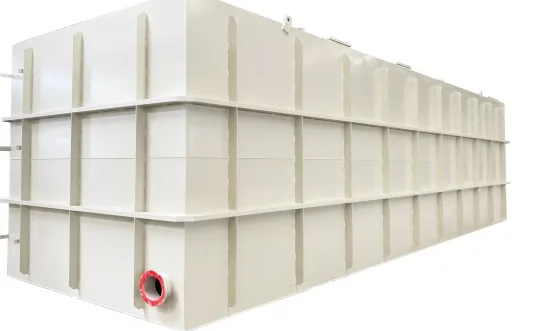
Basis
The anaerobic tank HRT and solids retention time values are from GB 50014-2021. The anoxic tank HRT is taken from GB 50014-2021 §7.6.17 and Tables 7.6.17 and 7.6.19, and cross-checked against HJ 576-2010 Tables 4 and 5. The extended-aeration range is from the Saudi MEWA guide.
Tank volume and HRT
HRT is the hydraulic residence time; SRT is the solids retention time. V is tank volume, Q is flow and HRT is the residence time.
| Parameter | Value | Source | Evidence level |
|---|---|---|---|
| Anaerobic tank HRT | 1–2 h | GB 50014-2021 Table 7.6.18 and Table 7.6.19 | National standard table |
| Anoxic tank HRT, A/O denitrification or AAO | 2–10 h | GB 50014-2021 §7.6.17, Table 7.6.17 and Table 7.6.19 | National standard clause and table |
| Anoxic tank HRT, HJ 576-2010 A/O or AAO | 2–4 h | HJ 576-2010 Table 4 and Table 5 | Industry standard table |
| Solids retention time, phosphorus removal as the main objective (ApO) | 3.5–7.0 d | GB 50014-2021 Table 7.6.18 | National standard table |
| Solids retention time, simultaneous nitrogen and phosphorus removal (AAO) | 10–22 d | GB 50014-2021 Table 7.6.19 | National standard table |
| Anoxic and aerobic tank volume split | The standard gives HRT and SRT ranges but no single fixed anoxic-to-aerobic volume ratio; the split is set by the nitrogen and phosphorus removal targets | GB 50014-2021 §7.6.16 to §7.6.19 | National standard clause, ratio not prescribed |
| Extended aeration, Middle East | Aeration 18–36 h; MLSS 3,000–6,000 mg/L; SRT 10–30 d | Saudi MEWA guide §1-3-1 and Table 2 | Official guide |
| Tank volume formula | V = Q × HRT; with Q in m³/day and HRT in h, V = Q/24 × HRT | GB 50014-2021 Eq. (7.6.18); HJ 576-2010 Eq. (3) | Standard equation |
The parameter values above carry the source and evidence level shown. The anoxic values are listed by standard and process configuration, not merged into one range. The volume formula is the unit conversion of V = Q × HRT.
Why these ranges, and when they apply
The table gives the values. This section explains what each zone does, why a range is stated instead of a single number, how to choose within it and where it stops applying. Value sources and explanation sources are kept separate: a table that fixes a range does not by itself explain the process.
Anaerobic zone HRT
1–2 hNational standard table
- Process purpose
- The anaerobic zone is the first zone of an A/O or AAO biological phosphorus removal train. It is mixed but not aerated, and nitrate-bearing returns are directed to the anoxic zone rather than to this zone. Because return sludge can carry some nitrate, the boundary is the flow arrangement, not a claim that the return stream is nitrate-free. Phosphorus-accumulating organisms release phosphorus there before the aerobic zone takes it up.
- Why the range exists
- The 1–2 h range is the table value for the anaerobic zone of biological phosphorus removal. It is not the retention time of an anaerobic digester, which is a separate sludge-treatment process.
- Choosing within the range
- Choose a value inside 1–2 h at the design flow of the zone. The same range appears in the national standard and in HJ 576-2010 for the A/O and AAO configurations.
- When not to use it
- Not valid as an anaerobic-digestion or sludge-stabilisation time, not a primary or fermentative sludge process, and not a peak-flow storage time.
Value source:GB 50014-2021, Outdoor Wastewater Engineering Design StandardGB 50014-2021 full-text mirrorHJ 576-2010, Technical specification for anaerobic-anoxic-oxic activated sludge wastewater treatment engineering
Explanation basis: Engineering interpretation of the zone function
Anoxic zone HRT, A/O denitrification or AAO (GB 50014-2021)
2–10 hNational standard clause and table
- Process purpose
- The anoxic zone is the denitrification stage: nitrate returned from the aerobic zone is reduced to nitrogen gas while the zone is mixed but not aerated.
- Why the range exists
- GB 50014-2021 gives the anoxic zone 2–10 h within the A/O denitrification table and the AAO table. It is a range, not a single design value.
- Choosing within the range
- Use the process configuration and the nitrogen-removal target to choose within 2–10 h. Keep this GB range separate from the HJ 576-2010 range for its own configurations.
- When not to use it
- Not a universal anoxic range for every process. Do not merge it with the HJ 576-2010 2–4 h value into one range, and do not use the superseded 2006 edition value.
Value source:GB 50014-2021, Outdoor Wastewater Engineering Design StandardGB 50014-2021 full-text mirror
Explanation basis: Engineering interpretation of the zone function
Anoxic zone HRT, HJ 576-2010 A/O or AAO
2–4 hIndustry standard table
- Process purpose
- The same denitrification duty, stated for the A/O and AAO configurations covered by HJ 576-2010.
- Why the range exists
- HJ 576-2010 Table 4 (A/O nitrogen removal) and Table 5 (AAO) give 2–4 h. The range is narrower than the GB 50014-2021 range because it belongs to this standard and its configurations.
- Choosing within the range
- Use 2–4 h when the design is being checked against HJ 576-2010. State which standard the value is taken from.
- When not to use it
- Not a sub-range of the GB 50014-2021 value and not a replacement for it. HJ 576-2010 does not give that superseded range; its appendix gives 0.5–1 h only for the first anoxic zone of the MUCT and JHB variants.
Value source:HJ 576-2010, Technical specification for anaerobic-anoxic-oxic activated sludge wastewater treatment engineering
Explanation basis: Engineering interpretation of the standard scope
SRT, phosphorus removal as the main objective (ApO)
3.5–7.0 dNational standard table
- Process purpose
- SRT is the solids retention time, or sludge age: the average time the sludge stays in the biological system. It controls the sludge inventory and the phosphorus-accumulating population.
- Why the range exists
- GB 50014-2021 Table 7.6.18 gives 3.5–7.0 d for the ApO biological phosphorus removal process, where phosphorus removal is the main objective.
- Choosing within the range
- Use 3.5–7.0 d only for an ApO train whose main objective is phosphorus removal. The nitrogen-removal duty pulls the required SRT higher.
- When not to use it
- Not an AAO simultaneous nitrogen and phosphorus removal value. Do not substitute this SRT into an AAO design, and do not compute SRT as V/Q.
Value source:GB 50014-2021, Outdoor Wastewater Engineering Design StandardGB 50014-2021 full-text mirror
Explanation basis: Definition of SRT and engineering interpretation
SRT, simultaneous nitrogen and phosphorus removal (AAO)
10–22 dNational standard table
- Process purpose
- Simultaneous nitrogen and phosphorus removal needs a longer sludge age so that nitrifiers and phosphorus-accumulating organisms both stay in the system.
- Why the range exists
- GB 50014-2021 Table 7.6.19 gives 10–22 d for AAO simultaneous nitrogen and phosphorus removal.
- Choosing within the range
- Use 10–22 d for an AAO train designed for both nitrogen and phosphorus removal.
- When not to use it
- Not interchangeable with the 3.5–7.0 d ApO value. SRT is not V/Q: the tank volume formula gives HRT, not sludge age.
Value source:GB 50014-2021, Outdoor Wastewater Engineering Design StandardGB 50014-2021 full-text mirror
Explanation basis: Engineering interpretation of the nitrogen-removal duty
Anoxic and aerobic tank volume split
No single fixed ratioNational standard clause, ratio not prescribed
- Process purpose
- The split between the anoxic and aerobic volumes sets how much denitrification capacity and how much nitrification and phosphorus uptake capacity the train has.
- Why the range exists
- GB 50014-2021 gives HRT and SRT ranges but does not prescribe one fixed anoxic-to-aerobic volume ratio.
- Choosing within the range
- Balance the split against the nitrogen and phosphorus removal targets of the project; the standard leaves the ratio to the process design.
- When not to use it
- Do not present a single ratio as a standard value. The standard does not state one.
Value source:GB 50014-2021, Outdoor Wastewater Engineering Design StandardGB 50014-2021 full-text mirror
Explanation basis: Engineering interpretation of the standard
Extended aeration time, Middle East
18–36 hOfficial guide
- Process purpose
- Extended aeration is a long-retention activated-sludge process; the aeration time is the basin retention time under this guide.
- Why the range exists
- The Saudi MEWA design guide gives 18–36 h for extended aeration in §1-3-1.
- Choosing within the range
- This is a regional guide value for the Middle East, not a national-standard value. Apply it only where the MEWA guide is the design basis.
- When not to use it
- Not a GB national-standard value. Do not apply this range to a project designed to GB 50014-2021.
Value source:Saudi MEWA, Design Guide for Wastewater Treatment Plants in Saudi Arabia
Explanation basis: Engineering interpretation of the guide value
Extended aeration MLSS, Middle East
3,000–6,000 mg/LOfficial guide
- Process purpose
- MLSS is the mixed-liquor suspended solids concentration in the aeration basin; it sets the solids inventory for a given basin volume.
- Why the range exists
- The Saudi MEWA design guide gives 3,000–6,000 mg/L for extended aeration in §1-3-1.
- Choosing within the range
- Use the value with the guide aeration time and SRT; it is a regional design basis, not a measured guarantee.
- When not to use it
- Not a national-standard value and not a compliance measurement. Confirm it against the project design and the operating range.
Value source:Saudi MEWA, Design Guide for Wastewater Treatment Plants in Saudi Arabia
Explanation basis: Engineering interpretation of the guide value
Extended aeration SRT, Middle East
10–30 dOfficial guide
- Process purpose
- SRT is the sludge age of the extended-aeration system; it is longer than in a conventional activated-sludge train.
- Why the range exists
- The Saudi MEWA design guide gives an SRT of 10–30 d in §1-3-1. Its Table 2 gives a temperature-dependent value, from 29 d at 12 °C down to 10 d at 27 °C, so the published range is a simplification.
- Choosing within the range
- Read the temperature-dependent table for the project water temperature rather than taking an endpoint of the range.
- When not to use it
- Not a GB value and not V/Q. SRT is not calculated as tank volume divided by flow.
Value source:Saudi MEWA, Design Guide for Wastewater Treatment Plants in Saudi Arabia
Explanation basis: Engineering interpretation of the guide value
Tank volume from flow and HRT
V = Q × HRTStandard equation
- Process purpose
- The equation turns a chosen hydraulic retention time into the effective working volume of the zone.
- Why the range exists
- GB 50014-2021 Eq. (7.6.18) and HJ 576-2010 Eq. (3) both write Vp = tpQ/24, which is V = Q × HRT once the time units match. With Q in m³/day and HRT in hours, V = Q ÷ 24 × HRT.
- Choosing within the range
- Match the time units first: the 24 converts days to hours. It is a unit conversion, not a safety factor.
- When not to use it
- This gives the effective working volume, not the total civil-construction volume. SRT cannot be substituted for HRT, and V/Q gives HRT, not SRT.
Value source:GB 50014-2021, Outdoor Wastewater Engineering Design StandardGB 50014-2021 full-text mirrorHJ 576-2010, Technical specification for anaerobic-anoxic-oxic activated sludge wastewater treatment engineering
Explanation basis: Definition and unit conversion
Sources
GB 50014-2021, Outdoor Wastewater Engineering Design Standard
Tables 7.6.17, 7.6.18 and 7.6.19; Eq. (7.6.18); §7.6.16 to §7.6.19
Official announcementGB 50014-2021 full-text mirror
Tables 7.6.17–7.6.19; Eq. (7.6.18); §7.6.16–7.6.19
Full-text mirror used for cross-checkHJ 576-2010, Technical specification for anaerobic-anoxic-oxic activated sludge wastewater treatment engineering
Tables 3, 4 and 5; Eq. (3)
Official PDFSaudi MEWA, Design Guide for Wastewater Treatment Plants in Saudi Arabia
§1-3-1 (p. 22–23) and Table 2 (p. 34)
Official PDF
Worked example: tank volume from flow and HRT
Flow Q = 1,000 m³/day. HRT = 1.5 h, an illustrative point inside the 1–2 h anaerobic range, not a table value.
- Convert the daily flow to an hourly flow: 1,000 ÷ 24 = 41.67 m³/h.
- Multiply by the retention time: 41.67 × 1.5 = 62.5 m³.
Effective working volume V = 62.5 m³.
This is the effective working volume of the zone at the chosen HRT. It is not the total civil-construction volume: freeboard, wall thickness, inlet and outlet structures and any sludge-storage allowance are added separately.
How to use and notes
- Use V = Q × HRT to turn a chosen residence time into a tank volume; Q is the flow at the point being sized. With Q in m³/day and HRT in hours, V = Q ÷ 24 × HRT; the 24 converts days to hours and is not a safety factor.
- Size hydraulic channels and pipes on the peak flow; design biological tanks on the average flow, load and SRT and make a peak hydraulic check; size equalization tanks from a flow hydrograph.
- The anaerobic zone is the phosphorus-release zone of an A/O or AAO biological phosphorus removal train. It is not an anaerobic digester: anaerobic digestion is a separate sludge-treatment process with a much longer retention time.
- The anoxic zone is where denitrification takes place. It is mixed but not aerated, and receives nitrate returned from the aerobic zone.
- SRT is the solids retention time, also called sludge age. It is not V/Q: dividing tank volume by flow gives HRT, not SRT.
- The standard gives HRT and SRT ranges but does not prescribe one fixed anoxic-to-aerobic volume ratio; the split is set by the nitrogen and phosphorus removal targets.
- The extended-aeration range is a Middle East convention from the Saudi MEWA guide, not a national-standard figure. Its SRT varies with water temperature: the guide gives 29 d at 12 °C down to 10 d at 27 °C.
- This chart does not provide HRT presets for A/O, MBBR, MBR or SBR. Use the anaerobic and anoxic figures above only for the duties and sources shown.
- Sludge load, carrier fill ratio and membrane flux require project process design and equipment configuration; they are outside this chart.