
On this page
An automatic polymer dosing system prepares and doses polyacrylamide solution and is commonly installed with coagulation and flocculation, sludge thickening and dewatering processes. Selection has to check the polymer consumption, the preparation and maturation capacity, the metering-pump working range and the automatic control functions the site needs, together.
What does the equipment consist of?
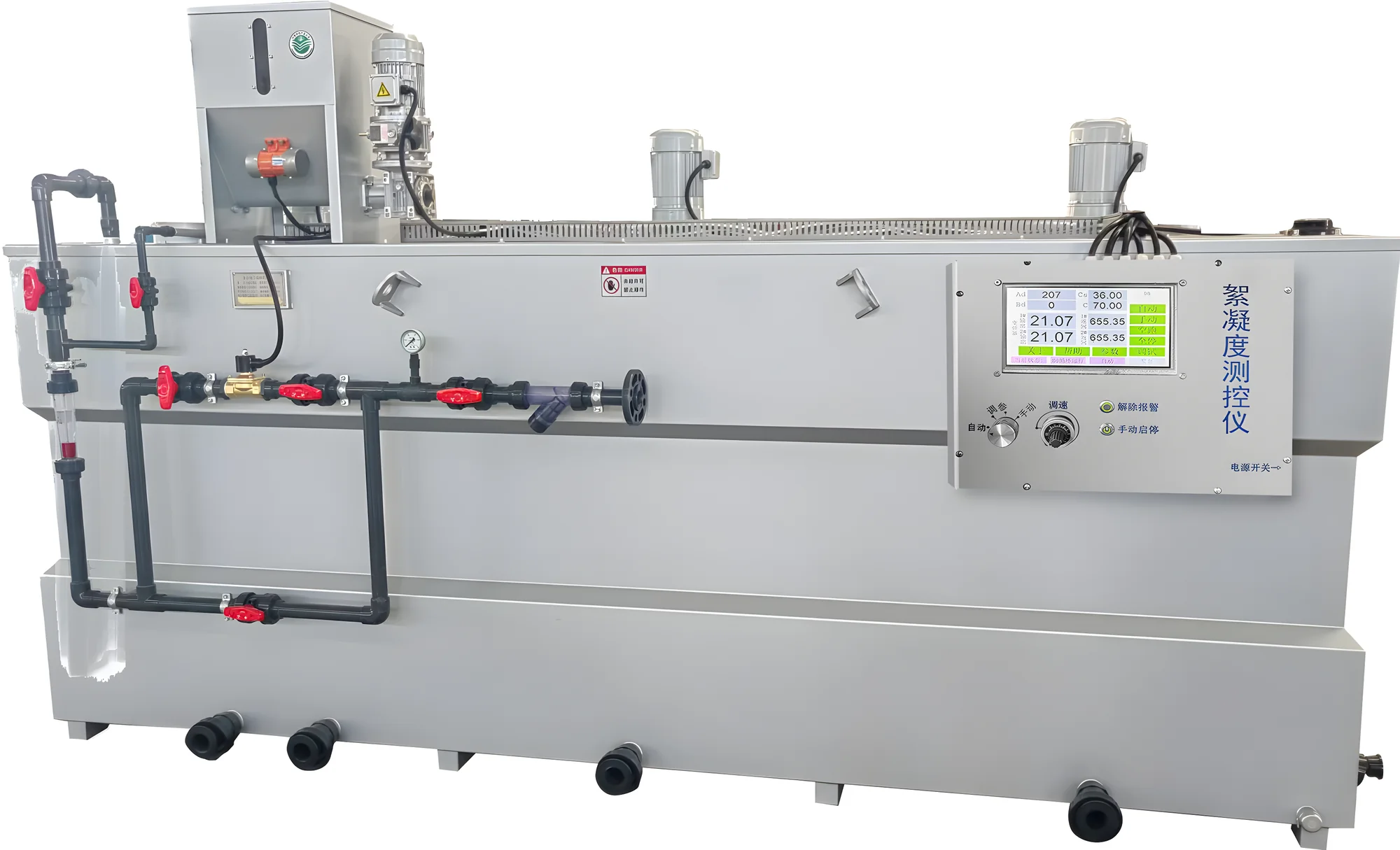
Take a powder system as the example; the table below divides the equipment by function. Preparation, maturation and storage can sit in separate compartments of the same tank, while the number of tanks and the pumps and instruments are confirmed per project.
Wide table: scroll sideways to see every column.
| Component | Function | Confirm at selection |
|---|---|---|
| Feed and wetting | Disperses the polymer into flowing water and prevents lumps | Polymer form, feed rate |
| Preparation tank | Mixes the working solution to the set concentration | Solution volume, concentration setting |
| Maturation tank | Provides the hold time for the molecular chains to uncoil and hydrate | Hold time, effective volume |
| Storage tank | Buffers the flow difference between preparation and dosing | Volume, operating regime |
| Metering pump and piping | Delivers the working solution to the injection point in L/h | Working range, viscosity, pressure |
| Control cabinet and instruments | Interlocks on level, flow or a set value | Control mode, signal interface |
Table 1: Typical components of an automatic dosing unit. The configuration is confirmed against the project and the polymer data.
Powder has to be wetted evenly. Dropping it in one place can form lumps that are gelled on the outside and still dry inside, so less polymer dissolves properly. Set the preparation concentration and the water and feed rates from the polymer data, and do not use extra powder to cover up a wetting problem.
Maturation lets the polymer hydrate fully and reach a usable state. Establish the maturation time and agitation requirement from the polymer supplier's data and the equipment design conditions first, then confirm them in a site trial. For continuous supply, the working volume V (L) ≈ solution flow q (L/h) × maturation time t (h); when selecting the tank, also check the effective volume, short-circuiting and intermittent operation.
What is the difference between automatic preparation and automatic control?
Automation reduces manual work such as weighing and mixing, and helps to limit batch-to-batch variation. At the purchasing stage, separate the functions below and write them into the configuration:
Wide table: scroll sideways to see every column.
| Function | What it controls | Confirm at selection |
|---|---|---|
| Automatic preparation | Feeds powder and make-up water at the set ratio, interlocked by level and other signals | Solution concentration, level and low-feed protection |
| Flow-proportional dosing | Adjusts the pump output with the influent or sludge flow | Flow signal, adjustment range and linkage |
| Treatment-effect feedback | Trims the dose further from an online measurement signal | Measured parameter, control logic and site validation |
The three control functions can be combined; the actual configuration follows the project scope.
Flow-proportional control follows a change in flow, and flow alone cannot establish the optimum dose after the water or sludge quality changes. Effect feedback also needs a suitable measurement signal and site validation, so 'automatic' must not be read as needing no trial or operating verification.
Our granted utility model CN216772272U (granted on 2022-6-17) describes a scheme that samples the fluid stream, detects the flocculation effect with an infrared photoelectric sensor and lets a PLC adjust the dosing pump. It is background to an optional engineering approach and not the CXJY standard configuration; flow linkage and effect feedback are each confirmed separately in a project.
How do you calculate polymer consumption and working-solution demand?
Enter the mass fraction as a decimal: 0.1% = 0.001. Solution density is in kg/L. The demand and the metering-pump flow are related as follows:
Assume a treated flow of 500 m³/h, a PAM dose of 1 mg/L on an active-polymer basis, established by trial and 20 hours of operation per day; the working solution has an active-ingredient mass fraction of 0.1%, and the dilute solution density is taken as 1 kg/L. The figures below are a calculation example, not a site measurement or a recommended dose.
Wide table: scroll sideways to see every column.
| Step | Calculation | Result |
|---|---|---|
| Active polymer demand | 1 mg/L × 500 m³/h ÷ 1000 | 0.5 kg/h |
| Daily active polymer use | 0.5 kg/h × 20 h/day | 10 kg/day |
| Working-solution mass demand | 0.5 kg/h ÷ 0.001 | 500 kg/h |
| Working-solution volume demand | 500 kg/h ÷ 1 kg/L | 500 L/h |
| Metering-pump check | Against viscosity, back pressure and the adjustable range | Covers the duty at about 500 L/h |
Table 2: Dose and solution demand under the assumed duty.
In the example, 10 kg/day is the active polymer quantity. To stock a commercial product, divide it by that product's active mass fraction. Preparation capacity and pump flow may both be stated in L/h, but the first describes how much solution the unit can make and the second how much is actually delivered, so they are not the same equipment parameter.
When selecting the preparation unit, check that it can meet the solution demand under the specified maturation conditions; continuous dosing does not necessarily require continuous preparation. The tank buffer volume, the mixing cycle and the operating hours per day have to be checked together, and a model cannot be fixed from 500 L/h alone.
Why does sludge dewatering need a separate calculation?
Sludge dewatering often states the polymer dose in kg/tDS, the mass of polymer per tonne of dry solids. Establish the dry-solids load first, then multiply by the trial dose, and state whether the dose is on an active-ingredient or a commercial-product basis. If only the sludge volume flow and the mass solids content are known, the sludge density is also needed to convert to dry-solids mass.
The screw press dewatering page describes how the dosing unit and the dewatering equipment are matched. The dewatering dose should be established with a sludge trial and confirmed in equipment operation; a water-treatment example cannot simply be applied.
What else has to be checked at selection?
- Polymer form and grade: a powder system is configured around the wetting, dissolution and maturation requirements; dilution and phase inversion of an emulsion follow the polymer supplier's data. The ionic type and product grade are selected through the duty and trials, and wetted materials are checked separately for media compatibility.
- Flow and operating pattern: give the normal and peak treated flow, the operating hours per day and whether operation is continuous or intermittent; a dewatering project also gives the dry-solids load.
- Solution and pumping conditions: check the working concentration, maturation time, solution viscosity, back pressure at the injection point and the pump's adjustable range, so that normal duty does not sit permanently at the bottom of the pump range.
- Site interfaces: confirm the make-up water source and supply conditions, the power supply, the installation space, the injection point and the flow, level and control signals to be connected.
The CXJY standard table lists three preparation capacities, 1000, 3000 and 4000 L/h, at 2.5, 3.3 and 3.3 kW respectively, with 304 stainless steel construction. The detailed specification is on the chemical treatment page; the actual configuration is confirmed against the polymer data, the maturation requirement and the duty conditions above.
How do you spot a dosing deviation in operation?
Wide table: scroll sideways to see every column.
| Check | How to check | Check first if it is abnormal |
|---|---|---|
| Actual pump output | Time the delivery into a calibration column; a gravimetric check needs the density to convert to volume | Pump setting, valves and piping condition |
| Polymer consumption | Compare one shift's actual consumption with the calculated figure on the same basis | Feed, make-up water, level and active content |
| Solution storage time | Record each preparation batch and manage it under the storage conditions the supplier allows | Temperature, storage time and mixing of old and new solution |
| Cake and filtrate | Observe the result and compare it with a validated duty | Feed sludge change, polymer and dose |
| Water or sludge quality change | Re-run the trial after a change of water source, sludge source or upstream duty | Whether the original dose still applies |
The checks locate a problem; no single observation is enough to call the dose low or high.
What should you prepare before asking us?
Send what you already know; items that are not yet clear can be left blank:
- Treated stream and injection point: raw water, wastewater or sludge, and whether the duty is clarification, thickening or dewatering.
- Flow and operating hours: normal and peak m³/h and operating hours per day; a sludge project also gives the dry-solids load, or the sludge flow, solids content and the basis on which it was measured.
- Trial dose: mg/L for water treatment and kg/tDS for dewatering, stating whether it is on an active-ingredient or a commercial-product basis; if no trial has been done, say so.
- Polymer data: product grade, powder or emulsion, ionic type and active content; any existing solution concentration and maturation data can be sent as well.
- Site conditions: make-up water source, power supply, installation space, back pressure at the injection point and the automatic control functions required.
If you have no jar-test result yet, you can still send the duty data, and we will use it to discuss the information the trial and the selection need. For dose trials, read coagulation and flocculation jar testing first; for a selection enquiry, use the form below or go to the contact page.