
On this page
Start from the sludge, not the machine
A sludge dewatering machine is chosen on four inputs: the sludge type, the feed solids concentration, the daily dry solids and the target cake. The machine family follows from those inputs, not from the model list. A comparison that starts with the catalogue tends to end with the machine the supplier prefers to build.
The four families covered here are the screw press, the belt filter press, the plate-and-frame (chamber) filter press and the vacuum belt filter. All four remove water mechanically. They differ in how the pressure is applied, how continuous the duty is, how much attention the unit needs, and how the water and the cake leave the machine.
Figures in this article describe method and relative behaviour. Cake dryness, capacity and polymer dose on your sludge are confirmed with the factory for your sludge rather than read from a general table.
The four sludge dewatering methods side by side
The table sets out the structural difference first, because most of the operating consequences follow from it.
Wide table: scroll sideways to see every column.
| Family | How the water leaves | Usual scale | Utilities and attention |
|---|---|---|---|
| Screw press | A slowly rotating screw conveys the sludge through a cylindrical screen; water drains through the screen while the screw compresses the solids against a back-pressure plate. | Small to medium duties, from a few kg of dry solids per hour to several hundred; our model table runs from 6 to 480 kgDS/h. | Low power, low wash water, polymer for conditioning, little attention once set. |
| Belt filter press | Gravity drainage on a moving belt, then wedge and roller pressure as the cake passes between belts. | Medium to large municipal and industrial duties. | Wash water for belt cleaning, higher power, an operator round for belt tracking and cake release. |
| Plate-and-frame press | Sludge is pumped into closed chambers lined with filter cloth; feed pressure drives the filtrate through the cloth and leaves a cake in each chamber. | Batch duties where a high dry-solids content matters, or where the sludge is difficult. | High feed pressure, cloth washing, a clamp and open cycle, labour for cake discharge. |
| Vacuum belt filter | A cake forms on a moving cloth and vacuum draws the filtrate through it; the cake can be washed on the belt before discharge. | Fine slurries and duties where the cake has to be washed as well as dewatered. | A vacuum pump, cloth wash, attention to the vacuum and the cloth. |
Four machine families and the operating consequences that follow from their structure.
Read the scale column as a shape rather than a limit. A screw press spans a single building to a municipal works; a belt press needs a continuous duty to justify an operator round; a plate-and-frame press is chosen for the cake; a vacuum belt filter for the slurry.
Screw press sludge dewatering: continuous, slow and simple
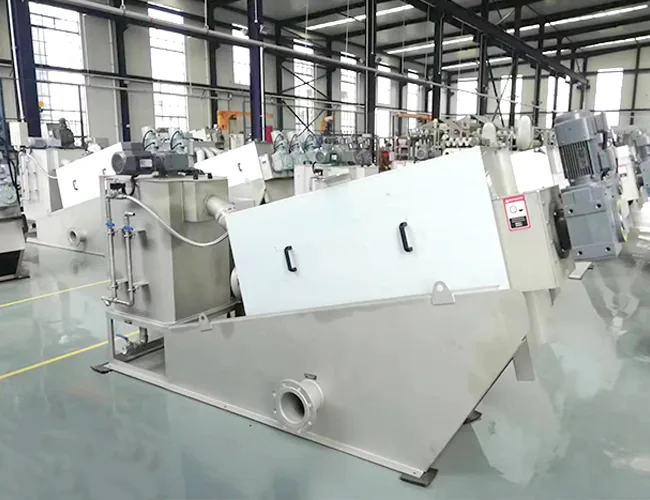
A screw press runs at low speed and takes the sludge continuously, which suits a plant that produces sludge through the day. The unit is compact, the power draw is small, and the wash-water demand is low, so it can sit inside a packaged plant without a separate wash-water system.
- Screw press sludge dewatering suits waste activated sludge, mixed sludge, manure and food-processing sludge where the duty is steady and operator presence is thin.
- The slow rotation keeps noise and wear down, but the screw and the screen are the parts that wear, and a blinded screen is the first thing that reduces capacity.
- Polymer conditioning still matters. A screw press without the right dose produces a wet cake and a dirty filtrate, whatever the model.
- Abrasive grit and fibrous material shorten the life of the screw and the screen; a grit removal or screening step ahead of the press is cheaper than a rebuild.
Our CXDL range covers 6 to 480 kgDS/h across the model table, with the whole duty, including the sludge pump, wash-water pump, polymer unit and control panel, mounted on one skid. The model that fits a given duty is confirmed with the factory for your sludge and your daily dry solids.
Screw press vs belt filter press on the same sludge
- Throughput: a belt filter press usually carries a larger dry-solids load per metre of width than a screw press of similar footprint, which is why it appears on larger municipal works.
- Attention: the belt press needs belt tracking, belt washing and a check on cake release; the screw press needs a dose check and a screen inspection. The difference is the number of operator rounds per shift.
- Wash water: the belt press uses wash water continuously to keep the belts open; the screw press uses much less, which matters where water is scarce or expensive.
- Cake consistency: both produce a handleable cake, and the drier of the two on a given sludge is a test result rather than a catalogue claim.
- Footprint and enclosure: the screw press fits into a packaged plant more easily; the belt press needs room for the belts, the wash box and the discharge conveyor.
- Screw press vs belt filter press is therefore a question of scale and staffing before it is a question of price. A small plant with one operator is usually served by the screw press; a large works with a shift team is usually served by the belt press.
Plate-and-frame and vacuum belt: the two specialised routes
A plate-and-frame press works in batches: fill the chambers, hold the feed pressure, open the press, discharge the cake. It reaches a drier cake than the continuous machines usually do on the same sludge, at the cost of labour, cloth maintenance and a cycle that does not follow the plant flow. Where disposal is charged by mass, that dryness can pay for the labour.
A vacuum belt filter is chosen where the slurry is fine and the cake has to be washed. Vacuum draws the filtrate through a cloth, and wash water applied to the cake removes a soluble component held in the cake liquor. It is a process unit as much as a dewatering unit.
Both are less forgiving of a feed that changes. A plate-and-frame press on a varying sludge needs the cycle adjusted; a vacuum belt filter with a blinded cloth loses vacuum and capacity together.
Utilities, wear parts and attention across the sludge dewatering methods
The operating cost is decided by what the machine consumes and replaces. Put the list beside the price.
Wide table: scroll sideways to see every column.
| Item | Screw press | Belt press | Plate-and-frame | Vacuum belt |
|---|---|---|---|---|
| Power | Low; one drive and small ancillary loads. | Moderate; drives, wash pump and vacuum where fitted. | High; feed pump and hydraulic clamp. | Moderate; vacuum pump and cloth drive. |
| Wash water | Low. | Continuous, for belt cleaning. | Intermittent, for cloth washing. | Continuous, for cloth washing. |
| Polymer | Required; the dose is set on the sludge. | Required; the dose is set on the sludge. | Often required; conditioning may also come from the feed. | Required where the slurry is fine. |
| Wear parts | Screw, screen, back-pressure plate. | Belts, rollers, bearings, doctor blades. | Filter cloths, plates, seals. | Filter cloth, vacuum pump, seals. |
| Attention | Low; a dose and screen check. | Medium; tracking and cake release. | High; a batch cycle with discharge. | Medium; vacuum and cloth condition. |
| Footprint | Small. | Large. | Medium, plus a discharge area. | Large. |
Utilities, wear parts and attention, compared by family.
The spare parts list belongs in the comparison. A machine whose wear parts are standard and stocked locally is cheaper over a plant life than one whose cloth or screw has to be imported on a long lead time. Ask for part numbers and lead times before the order, and ask which parts the supplier holds.
Common mismatches
Most disappointing installations trace back to a mismatch visible in the enquiry, and a sludge dewatering machine sized on the wrong basis is hard to correct later.
- Sizing on sludge flow rather than dry solids. Two sludges at the same flow can carry very different solids loads.
- Choosing a belt press for a duty that runs a few hours a day. The belt press rewards continuous operation and punishes stop-start running.
- Choosing a plate-and-frame press without the labour to run the cycle. The dryness is real; so is the operator time.
- Putting a screw press on a gritty or fibrous feed without grit removal or screening ahead of it.
- Choosing a vacuum belt filter where nobody can maintain a vacuum pump and a cloth.
- Comparing cake dryness from two suppliers without confirming that both figures are for the same sludge, the same feed solids and the same polymer dose.
- Forgetting the return liquor. The water removed at the machine goes back to the head of the plant carrying solids and ammonia, and the biological stage has to treat it.
- Buying on capital cost alone. The cheapest machine to install is not always the cheapest per tonne of dry solids over a plant life.
A decision path by sludge type
The path narrows the family; it does not size the unit.
- Waste activated sludge from a municipal plant, small or medium duty, thin operator cover: screw press.
- Mixed municipal sludge at a large works with a shift team and reliable wash water: belt filter press.
- Mineral or granular sludge, or a duty where the cake has to be as dry as the sludge allows and labour is available: plate-and-frame press.
- Fine chemical, mineral or process slurry where the cake has to be washed, or where a soluble component has to be recovered: vacuum belt filter.
- Manure, food-processing sludge and other high-organic feeds: screw press or belt press, decided on daily dry solids and on the fibre content of the feed.
- A feed that changes through the year: a continuous machine with a wider operating window before a batch machine, unless the cake target justifies the batch cycle.
Two checks close the decision. The first is a dewatering test on the actual sludge, because one family can behave differently on two sludges of the same name. The second is the utility balance: a machine that needs less power, wash water and polymer can be cheaper over a plant life even at a higher purchase price.
This article gives the method. The sludge dewatering hub carries the first-machine matrix that turns a sludge type, a volume band and a cake target into a starting family, with each family linked to its detail page; the model tables, belt or drum widths and wash-water figures stay on those detail pages.
The family, the model and the polymer dose that suit your plant are confirmed with the factory for your sludge, your feed solids and your target cake. The route from sludge type to a sized unit is set out in the sludge dewatering selection guide, and the four product pages describe the structure of each family.