
On this page
The extended aeration process, in one sentence
The extended aeration process is an activated sludge process run at a sludge age long enough that the biomass spends most of its time respiring its own stored material rather than growing on the incoming load. The aeration tank is larger, the time the water spends in it is longer, and the surplus sludge is a fraction of what a conventional plant of the same size produces. Almost everything else about the process follows from that one number.
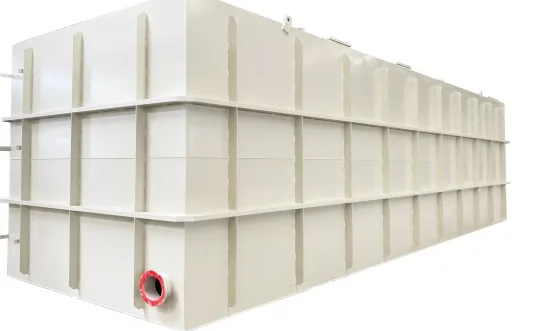
The name describes a sludge age rather than a tank shape. Plants of this kind are built as circular or rectangular tanks, as oxidation ditches, and inside packaged and containerised units. The geometry changes; the operating point does not, and that is why the term appears so often in small-plant specifications.
Why a long sludge age is the point
Three duties are met by the same decision.
- Sludge production falls. A conventional plant wastes a large share of the solids it grows; a plant held at a long sludge age oxidises much of that growth inside the tank, so both the wasting rate and the disposal bill that follows it come down. Surplus sludge production in wastewater treatment is decided here rather than in the dewatering room, and on a small site with nothing beyond a drying bed or a tanker, that is often why the process was chosen at all.
- Nitrification holds. Nitrifying organisms grow slowly, and a sludge age that would wash them out of a short-sludge-age plant in a cold spell keeps them in this one. A plant that nitrifies meets an ammonia limit without a separate stage, and — where the water carries enough alkalinity — without a chemical dose.
- Load swings are absorbed. A long sludge age means a large mass of biomass relative to the daily load, so a quiet weekend followed by a heavy Monday moves the food-to-microorganism ratio far less than it would move in a plant built on a short age. Where nobody is on site overnight, that buffer is worth more than the efficiency it costs.
The trade is real, and it is paid in two currencies: aeration energy and tank volume. A long sludge age buys simplicity and less sludge, and the price is electricity and concrete.
What the sludge age is, and how it is set
Sludge age, or sludge retention time, is the mass of solids held in the system divided by the mass removed from it each day. Solids leave by more than one route: the waste sludge line is the obvious one, and the suspended solids carried out in the clarified effluent are the other. Both count, and the second is the one that is usually forgotten.
On site the number is not calculated once and left alone. It is set by the wasting rate the operator runs, and it drifts whenever the load, the temperature or the return sludge rate changes. A plant that records its mixed liquor concentration and not its wasting volume has no sludge age at all, only an assumption.
The two retention numbers are easy to confuse because they move together here. They answer different questions, and the distinction is qualitative: the values themselves are in the design table below.
Wide table: scroll sideways to see every column.
| Aspect | Sludge age (SRT) | Hydraulic retention time (HRT) |
|---|---|---|
| What it counts | The solids inventory in the system, against the solids leaving it each day in waste sludge and in the clarified effluent | The nominal aeration-tank volume, against the influent flow through it |
| What changes it | The wasting rate and the solids carried out in the effluent; the return sludge rate redistributes solids within the system rather than removing them | The tank volume and the influent flow |
| What it does not tell you | How long any one litre of water stays in the tank | How long the biology stays in the system |
| How it is read here | The design intent of the process: long by choice | A consequence of holding a large solids mass at a low F/M |
A qualitative distinction; the design values are in the table further down the page
The solids concentration this age is held at is measured as MLSS; what that number includes, and what the volatile fraction does not, is set out in the MLSS and MLVSS article.
Extended aeration wastewater treatment: where it fits
The process earns its place where flows are small, operating attention is thin, and the load is close enough to domestic that the biology is not being asked to do two jobs at once.
- Small municipal and village plants, where a long sludge age removes the need for a separate sludge treatment route and for daily attention.
- Resorts, camps, construction sites and other seasonal or remote developments, where the plant may run unattended for days and the load arrives in bursts.
- Institutional sites — schools, clinics, barracks and office campuses — where the flow is steady enough for a stable biology and nobody wants a sludge problem on the premises.
- Industrial sites whose water is close to domestic in character: canteen and sanitary flow, small food preparation, vehicle washing.
The second half of that list matters as much as the first. Extended aeration is a process for water the biology can live on. A stream with a heavy and variable industrial load is a different problem, and a longer sludge age will not solve it.
The table is a qualitative decision aid for reading a site against the process. It is not a fit rule or a sizing table, and no capacity should be inferred from it.
Wide table: scroll sideways to see every column.
| Decision | What to check | Implication |
|---|---|---|
| Influent biodegradability | Confirm the water is amenable to biological treatment, and check for industrial inhibition and load variation | Assess whether equalisation or pre-treatment is needed before biological treatment; a longer sludge age does not by itself resolve an inhibitory influent |
| Land and power | Compare the footprint and aeration energy against the alternatives | Long retention and a large tank trade simplicity for land and electricity |
| Sludge production | Confirm that the reduced surplus sludge still has a wasting and disposal route | Lower sludge production still requires controlled wasting and an appropriate sludge handling and disposal route |
| Nutrient requirements | Check whether ammonia is the only nutrient limit, or whether nitrogen or phosphorus removal needs additional zones or steps | A long sludge age alone does not deliver total nitrogen or biological phosphorus removal; the need is confirmed per project |
| Operation and maintenance | Confirm who monitors the plant and performs the routine maintenance | Assign responsibility for blowers, return pumps, controlled wasting and process monitoring |
Qualitative decision aid, not a fit rule
Extended aeration sewage treatment plants: the shape of the design
The ranges below are the figures quoted in municipal design practice — in China, GB 50014-2021 — and in the standard texts on activated sludge. They are a starting method rather than a specification: every one of them is confirmed against the influent, the design water temperature and the particular clarifier on the site.
Wide table: scroll sideways to see every column.
| Parameter | Order of magnitude | What sets it |
|---|---|---|
| Sludge age (SRT) | 20–30 days | holding nitrifiers through the coldest month |
| Hydraulic retention time | 18–36 hours in the aeration tank | a large solids mass held at a low F/M |
| Mixed liquor solids (MLSS) | 3,000–5,000 mg/L | what the final clarifier can separate |
| Food-to-microorganism ratio | 0.05–0.15 kg BOD per kg MLSS per day | the low end of the activated sludge range |
| Return sludge rate | 100–150 % of influent (some published ranges start at 50 %) | holding the blanket inside the clarifier |
| Aeration | the largest electricity load on the plant | the first place an energy review looks |
For the retention arithmetic on an existing tank, the HRT calculator converts between volume, flow and retention time.
A plant inside that band can still be short of nitrification in winter. The sludge age nitrification needs rises as the water cools and as dissolved oxygen falls, and it is the coldest month's water rather than the annual average that sets it. Where a plant in the band fails on ammonia in the cold, the cause is usually dissolved oxygen or alkalinity rather than the sludge age itself — and the band already carries a margin over the minimum sludge age, which is why it is stated as a design target rather than as a floor.
What is missing from that list matters too. There is usually no primary clarifier, because there is little settleable sludge to take out and the load can go straight to the aeration tank. There is usually no digester either, because the long sludge age has already stabilised most of what the tank produces. The screen and the grit trap do not go away with the primary clarifier: whatever arrives with the flow still has to be taken out in front of the tank, and how much of it, and whether a grit trap is warranted at all, depends on the sewer and the site.
Long sludge age in wastewater treatment: what it costs
- Aeration energy. Respiration of the biomass itself consumes oxygen, so the aeration demand per kilogram of load removed sits near the top of the activated sludge range. On a small plant this is the largest electricity line, and it is the reason the process is not chosen where power is expensive and land is not.
- Tank volume. Retention time and solids concentration together set the aeration tank, and a long sludge age takes a large share of the footprint for the tank rather than for clarification.
- Settling risk. A high mixed liquor concentration loads the final clarifier, and biomass held at a low food-to-microorganism ratio settles differently from a young sludge. Where the sludge volume index climbs, the first question is which filament is responsible — Microthrix parvicella and the type 0092 filaments are the ones most often reported in plants run at a low food-to-microorganism ratio — and a settled-sludge test or a microscope answers it before anything is changed. The control then follows from what the test shows: a selector, a change in the aeration pattern, or a change in the return sludge. Raising the wasting rate is not among them, because it shortens the sludge age the plant was built for.
- Denitrification in the clarifier. Where nitrification is complete and the blanket is deep, nitrate keeps being reduced below it and the gas lifts solids to the surface. Rising sludge of that kind is a consequence of the design, not an operator error.
- A colder margin than the numbers suggest. The sludge age is held by the wasting rate, so a cold spell does not lengthen it; it lengthens the time the biology needs. A plant that is comfortable at 20 °C can be marginal at 10 °C with no change at all to the wasting rate.
Nitrification and alkalinity: the cost that is not on the power bill
Nitrification consumes alkalinity — about 7.14 mg of alkalinity as CaCO₃ per milligram of ammonia nitrogen oxidised, and denitrification returns about 3.57 mg per milligram of nitrate reduced. A domestic-strength sewage carrying of the order of 30 to 50 mg/L of ammonia nitrogen therefore takes 210 to 360 mg/L of alkalinity out of the water before the ammonia limit is met. Where the influent alkalinity is only a little above that figure the residual is thin: the pH drifts down as nitrification proceeds and the biology slows before the limit is reached. The figure to design against is the residual alkalinity at the end of the aerobic zone in the coldest month, not the alkalinity of the raw water.
That makes the "no chemical dose" case conditional rather than free. Where there is alkalinity to spare, a long sludge age nitrifies without reagents. Where there is not — soft surface water, a rainwater-fed supply, some industrial mains — alkalinity or pH correction is a reagent line that belongs in the design, monitored on the plant rather than discovered in the effluent. Returning nitrate to an anoxic zone recovers part of that alkalinity, which is one more reason the two zones are designed together.
Where a long sludge age is the wrong answer
Four cases are worth naming, because in each of them the process is chosen for a reason that does not survive contact with the site.
- A high-strength industrial discharge. The process assumes the biology is fed at something close to a domestic rate. An industrial stream with a heavy organic load and a salt or inhibitor content needs equalisation and pre-treatment first, and the sludge age is not the deciding question until that is done.
- A plant that has to remove phosphorus biologically. Enhanced biological phosphorus removal depends on wasting sludge that is rich in phosphorus, which means a shorter sludge age and a defined anaerobic zone. A long sludge age works against the same objective, and a plant designed for both usually achieves neither without a chemical fallback.
- A site where land is the constraint. The process pays for its simplicity in tank volume. Where the footprint is fixed, a membrane bioreactor does the same job in less area and charges for it in energy and membrane maintenance, which is a different trade rather than a better one.
- A discharge with a total nitrogen limit. A long sludge age nitrifies reliably but does not denitrify on its own, and nitrification only moves the nitrogen from ammonia to nitrate. A total nitrogen limit needs an anoxic volume, or cyclic aeration in the same tank, sized and checked as a denitrification duty rather than assumed to follow from the sludge age.
For other process options, the MBR, MBBR and SBR comparison covers footprint, effluent requirements and operating duties.
Common mistakes
- Treating extended aeration as a size of plant rather than as an operating point. Two tanks of the same volume are not the same plant if one is wasting five times as much sludge as the other.
- Cutting the wasting rate to cure a rising sludge blanket. Less wasting puts more solids in the tank and a heavier load on the clarifier, which is how the problem began.
- Trimming the aeration to save electricity on a plant that is already short of oxygen. The saving appears in the effluent ammonia long before it appears in the bill. The saving that does exist is in control rather than in hours: a dissolved-oxygen signal driving a variable-speed blower, or intermittent aeration on a small plant, cuts average airflow while holding the oxygen the biology needs. What it must not do is chase a fixed setpoint through a cold spell or a peak load — the control range comes from the plant's own oxygen demand, not from a nominal figure quoted for another site.
- Designing on a warm-season sample. Nitrification is the first thing a plant built on summer data loses, and it loses it in the first winter.
- Confusing sludge age with hydraulic retention time. In this process the two move together by design, but they are separate numbers, and a tank sized on the wrong one is the wrong size.
Self-check before the process is chosen
- Has the sludge age been set from the coldest temperature the plant will see, rather than from the annual average?
- Has the surplus sludge been estimated as a quantity, with a route for it, rather than assumed to be negligible?
- Can the final clarifier hold a mixed liquor of the concentration the process needs, and is the return sludge capacity there?
- Is the aeration sized for the peak oxygen demand, and is there a plan to measure what it consumes?
- Will anybody record the wasting volume, or will the sludge age be whatever it happens to be?
From a sludge age to a plant
- A sludge age of 20 to 30 days buys less surplus sludge, reliable nitrification and a plant that absorbs load swings.
- It pays for that in aeration energy and tank volume, and its nitrification is only as free as the alkalinity allows.
- It is the wrong process for a heavy industrial discharge, for biological phosphorus removal, for a site where land is the constraint, and for a discharge with a total nitrogen limit.
The sludge age is the whole design in one number, which is why it belongs in the specification rather than being left to commissioning. The article on the activated sludge process sets out the four decisions that size the tank, and the tank volume and retention time chart turns a residence time into a basin volume. The containerized sewage treatment plant page sets out how a biology of this kind, a clarifier and an aeration blower are packaged into a unit that can be shipped and set down, and the sludge age and aeration rate that suit your flow are confirmed with us for your influent rather than taken from a band.