
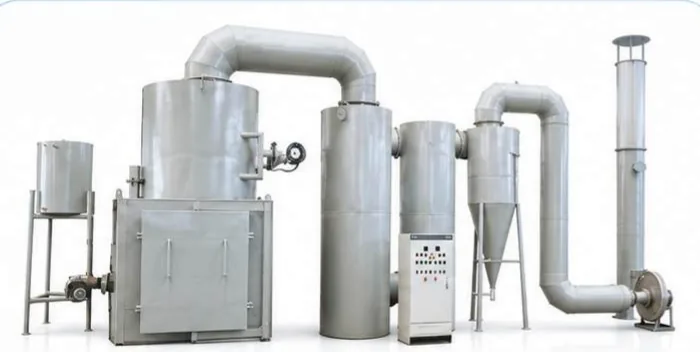
Basis
The combustion and process parameters in the first table and the configuration values in the second are our published design values for the CXMWI medical-waste series. They are not national standard values or test results, and they are not a statement of current supply for municipal, industrial or animal-waste ranges. National numerical limits, their reference conditions and scope are in the separate country lookup; this chart does not reproduce them. The chart keeps the NOx design limitation: the standard configurations use combustion control only, and the optional low-NOx stage is a per-project option.
Combustion and process parameters
These are the design values we publish for the CXMWI medical-waste series, on a hospital clinical-waste basis. They are design values, not national standard values or third-party test results.
| Parameter | Published value | Source | Evidence level |
|---|---|---|---|
| Incineration temperature | ≥850 °C | Our published data | Our published value |
| Flue-gas residence time | ≥2.0 s | Our published data | Our published value |
| Waste volume reduction | Up to 90 % by volume, the balance becoming ash and flue gas | Our published data | Our published value |
| Combustion temperature range, process description | 800–1,200 °C | Our published data | Our published value |
The values in this table describe the CXMWI medical-waste series only. They are design values, not measurements, and a unit is confirmed per configuration and project.
National emission limits by country
Numerical national and regional emission limits, reference conditions, averaging periods and scope notes are in the separate country lookup. This chart keeps the manufacturer process and configuration data; use the lookup to compare jurisdiction limits. Permits and current law still govern a project.
Open the country emission-standards lookupWhat the three supplied configurations of the CXMWI medical-waste series reach
Design values for the three purification configurations of the CXMWI medical-waste series, stated by us on a common reference basis of 11 % oxygen in dry gas. Where our configuration-table versions differ on the same parameter, the latest confirmed configuration table takes precedence. Nitrogen oxides are the production-confirmed exception: 350 mg/m³ is the standard design value for all three configurations, and a 200 mg/m³ figure is not a current configuration value; it exists only as the optional low-NOx project stage below. These are design values confirmed per configuration and project, not third-party test results; whether an installation reaches a site limit is established by testing after installation.
| Parameter | A — Purification chamber | B — Venturi, packed tower and cyclone | C — Quench, activated carbon and bag filter |
|---|---|---|---|
| Particulates | 50 | 30 | 10 |
| CO | 50 | 50 | 50 |
| HCl | 40 | 30 | 8 |
| SO₂ | 70 | 60 | 40 |
| HF | 4 | 3 | 0.8 |
| NOx | 350, no denitrification | 350, no denitrification | 350 standard; ≤200 only with an optional low-NOx stage, engineered per project and verified by third-party testing after installation |
| Dioxins and furans, ng TEQ/Nm³ | ≤0.8 | ≤0.5 | ≤0.1 |
All values are mg/m³ unless stated. Nitrogen oxides are controlled by combustion in all three configurations; no SNCR or SCR stage is fitted, so the standard configurations do not meet the Chinese medical-waste NOx benchmark in the country lookup. 350 mg/m³ is the standard NOx design value for all three configurations. A 200 mg/m³ figure is not a current configuration value: it exists only as the optional low-NOx stage (≤200 mg/m³), engineered per project and verified by third-party testing after installation; it is not standard supply. Where a site limit is below the standard design value, a denitrification stage would have to be engineered separately. Mercury, lead and cadmium are quoted only as a combined figure confirmed per configuration and project; no fixed A/B/C value is published. No third-party emission test report is provided with the unit: each unit is subject to a factory acceptance test before shipment, and emission testing after installation is arranged by the site to the local requirement.
How to read these tables
The first table gives our design values for the CXMWI medical-waste series; the second gives design values for the three purification configurations. Read each table with the configuration, facility scope, oxygen basis and project conditions that apply to it. National regulatory limits are in the separate country lookup; this chart does not reproduce them, and a design value does not show that a supplied unit is tested to a regulatory limit or will reach it. Value sources and explanation sources are kept separate.
Secondary-chamber design temperature
≥850 °COur design value (first-party)
- Process purpose
- Secondary-chamber temperature for the CXMWI medical-waste series.
- Why the value is stated this way
- The P26 design parameters give 850 °C, and the sales-training process facts give the same figure for the medical-waste series.
- How to read the table
- This is a fixed design parameter, not a range to choose from, and it applies to the medical-waste series only.
- When not to use it
- A design value, not a measurement and not a result for a particular waste or installation.
Value source:Confirm-version incinerator learning material, MWI-SMWI model revision (2)Medical-waste incinerator market and sales training, 2026-10-10
Explanation basis: Engineering interpretation of our design statement
Flue-gas residence time
≥2.0 sOur design value (first-party)
- Process purpose
- Flue-gas residence time in the high-temperature section of the CXMWI medical-waste series.
- Why the value is stated this way
- The P26 design parameters give 2.0 s, and the sales-training process facts give the same figure.
- How to read the table
- A fixed design parameter for the medical-waste series, not a range to choose from.
- When not to use it
- A design value, not a measurement at a particular installation.
Value source:Confirm-version incinerator learning material, MWI-SMWI model revision (2)Medical-waste incinerator market and sales training, 2026-10-10
Explanation basis: Engineering interpretation of our design statement
Waste volume reduction
Up to 90 % by volumeOur design statement (first-party)
- Process purpose
- The share of waste volume that combustion can remove, the balance becoming ash and flue gas.
- Why the value is stated this way
- The sales-training process facts state volume reduction up to 90 %; the same statement keeps the ash and flue-gas balance.
- How to read the table
- Read the figure as an upper design figure for a suitable waste, not as a fixed reduction for every batch.
- When not to use it
- Not a measured reduction and not a result for a particular waste composition; the residue still needs disposal.
Value source:Medical-waste incinerator market and sales training, 2026-10-10
Explanation basis: Engineering interpretation of our process statement
Process temperature band
800–1,200 °COur process description (first-party)
- Process purpose
- A process description of the combustion temperature band, not a minimum secondary-chamber temperature.
- Why the value is stated this way
- The 1,200 °C upper bound is stated in our English brochure p.160; the 800 °C lower bound is our own process description and is not a vendor table value.
- How to read the table
- Read it as a process description only. It is not a selectable operating range and not a minimum secondary-chamber temperature.
- When not to use it
- Never present this band as a secondary-chamber minimum; it is not the temperature requirement of a national standard.
Value source:Incinerator English brochure, revised 2026-10-12
Explanation basis: Engineering interpretation of our process description
NOx design value, standard configuration
350 mg/m³Our design value (first-party)
- Process purpose
- Standard NOx design value for configurations A, B and C of the CXMWI medical-waste series.
- Why the value is stated this way
- Our production confirmation of 2026-10-23 gives 350 mg/m³ for all three configurations, with combustion control only and no denitrification stage.
- How to read the table
- This is the standard configuration figure. A lower figure is not part of the standard supply.
- When not to use it
- A design value, not a third-party test result. The standard configuration is not designed to reach the 300 / 250 mg/m³ national limit.
Value source:Production confirmation, 2026-10-23 (A/B/C standard table and medical-series scope)
Explanation basis: Engineering interpretation of our production confirmation
NOx with the optional low-NOx stage
≤200 mg/m³, optionalOur per-project option
- Process purpose
- Optional low-NOx stage for configuration C when a project limit requires it.
- Why the value is stated this way
- Our production confirmation of 2026-10-23 records the low-NOx stage as an option, not as standard supply.
- How to read the table
- Offered only as an optional, project-engineered stage. It does not apply to configurations A and B.
- When not to use it
- Engineered per project and verified by a third-party emission test after installation; not standard supply and not a fixed value for every project.
Value source:Production confirmation, 2026-10-23 (A/B/C standard table and medical-series scope)
Explanation basis: Engineering interpretation of our production confirmation
Heavy metals per configuration and project
Confirmed per configuration and projectOur project confirmation
- Process purpose
- Mercury, lead and cadmium are controlled by the purification configuration and cannot be read from one fixed A/B/C row.
- Why the value is stated this way
- Our two first-party configuration tables do not give the same parameter: one gives a mercury row, the other a combined mercury, lead and cadmium row. The figures are therefore not interchangeable.
- How to read the table
- Ask for the combined metal figure for the configuration and project. Do not combine a mercury figure with a differently labelled total.
- When not to use it
- No fixed A/B/C heavy-metal value is published; the figures are confirmed per configuration and project and are not third-party test results.
Value source:Confirm-version incinerator learning material, MWI-SMWI model revision (2)Production confirmation, 2026-10-23 (A/B/C standard table and medical-series scope)
Explanation basis: Engineering interpretation of the two first-party tables
Supply scope
CXMWI medical-waste series onlyOur supply boundary
- Process purpose
- This page presents the medical-waste series; it is not a statement of current supply for other waste types or models.
- Why the value is stated this way
- Our current supply for this page is the CXMWI medical-waste series.
- How to read the table
- For municipal, industrial, animal or other waste, confirm the applicable model and scope separately before relying on this page.
- When not to use it
- Only the CXMWI medical-waste series is presented; no other model series or waste type is offered here as a supply capability.
Value source:Production confirmation, 2026-10-23 (A/B/C standard table and medical-series scope)
Explanation basis: Engineering interpretation of our supply scope
Two first-party tables
Stricter value shown for retained same-parameter rowsOur evidence rule
- Process purpose
- Our two first-party configuration tables do not agree on every emission parameter, so the rule needs a scope.
- Why the value is stated this way
- For the same-parameter rows retained on this page, the stricter of the two first-party figures is shown. Nitrogen oxides are a production-confirmed exception and follow the standard and optional boundaries stated in the NOx items.
- How to read the table
- Read a retained figure as the stricter of the two for that row, confirmed per configuration. Do not average the two tables, and do not read the optional low-NOx figure as a current configuration value.
- When not to use it
- The rule applies only to the same parameter. It is not used for NOx, and not used to combine a mercury figure with a mercury, lead and cadmium total.
Value source:Confirm-version incinerator learning material, MWI-SMWI model revision (2)Production confirmation, 2026-10-23 (A/B/C standard table and medical-series scope)
Explanation basis: Engineering interpretation of the two first-party tables
Sources
GB 18484-2020, Standard for pollution control on hazardous waste incineration
Section 1; Table 1; Table 3; definition of the 11 % O2 reference
Official PDF (MEE)GB 39707-2020, Standard for pollution control on medical waste treatment and disposal
Table 1; Table 4; definition of the 11 % O2 reference
Official PDF (MEE)GB 18485-2014, Standard for pollution control on municipal solid waste incineration
Table 1; Table 4; definition of the 11 % O2 reference
Official PDF (MEE)Directive 2010/75/EU on industrial emissions, Annex VI Part 3
Annex VI Part 3: NOx 200 mg/m³ at 11 % O2 in dry gas
EUR-LexSouth African Government Notice 893, National Environmental Management: Air Quality Act emission standards
NOx 200 mg/m³ at 10 % O2 in dry gas; no stable public URL recorded, so no link is given
Confirm-version incinerator learning material, MWI-SMWI model revision (2)
P26 design parameters; P27 three-configuration comparison table
Medical-waste incinerator market and sales training, 2026-10-10
p.319 confirmed process facts; sales wording only, no test report
Incinerator English brochure, revised 2026-10-12
p.160 maximum temperature up to 1,200 °C
Production confirmation, 2026-10-23 (A/B/C standard table and medical-series scope)
A/B/C emission rows, NOx confirmation and supply scope (2026-10-23); design values only
How to use and notes
- The combustion parameters in the first table are our published design values for the CXMWI medical-waste series and carry that status only. They are not national standard values and must not be presented as such.
- National numerical limits are in the country lookup, including the China medical-waste entry and its NOx benchmark. Use the emission-standards link on this page to check the applicable values and reference conditions.
- The standard CXMWI configurations are designed for 350 mg/m³ NOx with combustion control only and no denitrification stage. That design value does not meet the Chinese medical-waste NOx benchmark. The optional low-NOx stage targets ≤200 mg/m³, is engineered per project and verified by third-party testing after installation; it is not standard supply and is not a fixed value for configurations A and B.
- A local or provincial standard, an environmental impact assessment condition or a permit may be stricter than the national benchmark; always check the permit that applies to the site.
- The design values in the second configuration table are our figures for the CXMWI medical-waste series. They are not third-party test results, and the contractual guarantee for a specific model is confirmed with the quotation.