
On this page
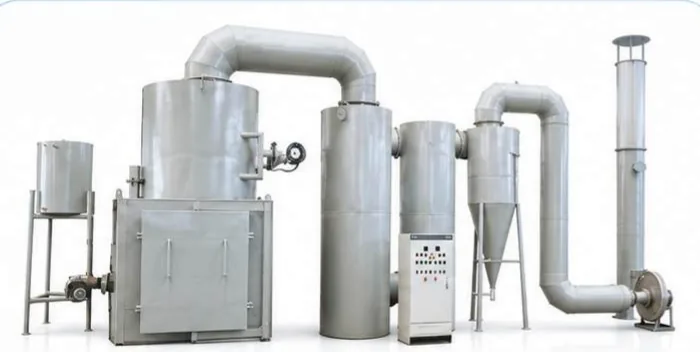
A medical waste incinerator is a furnace built to destroy infectious and pathological waste, not merely to burn it. It does that in two chambers: the first turns the waste into gas and ash, the second burns the gas itself, and a flue-gas train then cleans what leaves. The distinction matters, because a single-chamber burner with a chimney can also be called an incinerator, and it is not the same machine.
What counts as medical waste
Medical waste is a set of categories rather than one material: infectious waste, sharps, pathological waste, pharmaceutical waste, chemical waste and radioactive waste. A medical incinerator is designed around the first three and, within limits, expired pharmaceutical stock. Radioactive waste and much of the chemical fraction are outside what the machine is built to handle, and belong on a different route.
The waste also arrives wet, mixed and in bags. That is why the design works on a batch of material rather than a continuous stream: the charge is weighed, loaded, burned as a batch and discharged before the next one.
Two chambers, two jobs
The primary chamber receives the waste; the secondary chamber receives the gas. They are separate because the two reactions need different conditions. Solids need time on a bed with a controlled air supply. Gases need a high temperature, turbulence and enough oxygen, held long enough for the reactions to finish.
Inside the primary chamber
Three things happen in sequence, and they overlap in time. Drying comes first: the water in the waste leaves, and it takes energy with it, so a wet charge spends a large part of the cycle evaporating water before any waste is destroyed.
Pyrolysis follows. As the bed heats, the volatile part of the waste breaks down and leaves as gas, with too little oxygen around it to burn inside the bed.
Oxidation finishes the job: the carbon left behind burns on the grate under added air, and what remains is ash. The three stages explain why the loading procedure matters — a charge packed too tightly starves the bed of air and the cycle stalls.
The secondary chamber and the 2-second rule
The gas leaving the primary chamber still contains combustible material. The secondary chamber holds it at or above 850 °C with excess oxygen for at least 2.0 seconds. That combination — a temperature held for that long, with enough air and turbulence — is what completes the oxidation of the compounds that would otherwise leave as dioxins, furans and carbon monoxide.
The operating band is 800–1,200 °C. Below it, combustion is incomplete and the gas carries forward what should have been destroyed. Above it, the ash begins to soften, the refractory wears faster, and more of the material volatilises into the gas stream than the cleaning train was sized for.
The 850 °C and 2.0 s figures are not a marketing number. They are the pair most national rules for medical waste incinerators converge on, and they are the first thing an inspector asks a plant to demonstrate — not from a brochure, but from the temperature record.
What happens to the gas afterwards
The gas leaves the secondary chamber hot and acidic. The first step is cooling, through a quench or a heat exchanger, because the stages behind it work within a temperature range and the ducting has a limit of its own.
In the dry configuration the gas passes through filter bricks of calcium hydroxide, which neutralise acid gases and adsorb part of the pollutants. It is the simpler train, and it is what a small clinic unit can be operated with.
In the wet configuration the gas is quenched, washed against acid, passed over activated carbon and stripped of dust before it reaches the stack. It removes more and costs more to run: water, chemicals, and a liquid effluent that has to be handled rather than discharged.
Which of the two applies is set by the emission limits in force at the site, not by preference. A country with a strict dioxin limit needs the wet train, or a dry train with the sorbent and the monitoring to prove the result.
What sets the size
Wide table: scroll sideways to see every column.
| Input | What it decides | Where the number comes from |
|---|---|---|
| Waste generated per day, in kg | Charge size, cycles per day, chamber volume | Weighed waste from the site, not a per-bed allowance on its own |
| Batch or continuous loading | Door size, loading procedure, staffing | How the site actually operates, including the night shift |
| Moisture and calorific value | Auxiliary fuel demand, cycle time, capacity actually achieved | The waste composition; wet pathological waste behaves differently from dry dressings |
| Operating hours per day | Whether one unit covers the site or two | The shift pattern and the storage time of the waste |
| Ash and residue handling | Discharge access, container, disposal route | Local disposal rules |
The nameplate figure is a batch capacity; what a site processes in a day follows from these rows.
What the operator does every day
- Load to the procedure for the model: a charge weight, not a chamber filled to the door
- Bring the secondary chamber to temperature before charging, and hold it there through the cycle
- Watch the primary chamber against its operating band, not just the secondary
- Discharge the ash and keep it out of the chamber between cycles
- Record the temperatures and the charges — that record is what an inspection asks for
What must not go in
- Radioactive waste, at any activity level
- Pressurised containers and aerosols
- Bulk chemical stocks, which follow a separate route
- Waste with a high halogen or heavy-metal content, unless the flue-gas train is sized for it
Where these units fail
Most failures at this scale are operational, not mechanical. A chamber loaded by volume rather than by weight carries far more than the design charge. A secondary chamber held just below its set point passes the compounds it exists to destroy. Ash left in the primary chamber between cycles glues the next charge to the bed.
The second failure is sizing. A site that weighs its waste and buys on the daily figure does better than one that buys on beds, because the per-bed allowance hides the difference between a clinic and a district hospital.
Incineration is not the only route
For infectious waste that can be sterilised, an autoclave or a microwave unit does the job with less fuel, less emission control and a simpler permit. Incineration is chosen where the waste is pathological, where it cannot be sterilised, or where no treatment chain exists at all. Which of the two a site needs is a separate decision, and it comes before the equipment.
Frequently asked
How hot does a medical waste incinerator get? The primary chamber runs lower; the gas in the secondary chamber is held at or above 850 °C, inside an operating band of 800–1,200 °C.
Why two chambers instead of one? Because the waste and the gas need different conditions. One chamber cannot give the bed time and the gas turbulence at the same time, which is why a single-chamber burner releases what a second chamber would have destroyed.
Can it burn general waste as well? It is designed around medical waste. Mixed general waste changes the calorific value, the moisture and the emission profile, and the flue-gas train is sized for the waste it was specified with.
What decides how much it can process in a day? The charge weight, the number of cycles, and the moisture of the waste. The capacity is a batch figure, and the daily figure is that batch multiplied by the cycles the operator can actually run.
The next step is not a model number but a set of site figures: the waste generated per day, how it is stored, the operating hours and the emission limits that apply. Our capacity page turns the first of those into a model range, and the emission standards page covers the second.