
On this page
What a large plant’s flue-gas train actually does
A large municipal waste-to-energy plant burns waste on a moving grate or in a fluidised bed. The gas leaves the furnace at 850 °C or above and is held there for at least two seconds after the last combustion-air injection. From that point to the stack, the plant runs a train of stages. The order is set by temperature and chemistry rather than by preference.
The first stage is heat recovery. A water-wall boiler takes the gas down to a temperature the next stage can accept, and produces steam for a turbine. The same vessel is also the first cooling stage, which is easy to forget when the boiler is described only as an energy-recovery item.
- Nitrogen oxides. Staged combustion, flue-gas recirculation, SNCR in the furnace or SCR downstream of the boiler. Nitric oxide is only slightly soluble, so it is not a scrubbing problem.
- Acid gases. A semi-dry spray-dryer absorber with lime slurry, often followed by dry lime injection; a wet scrubber where the limit or the waste demands more removal.
- Mercury and dioxins. Activated carbon injected into the duct, captured on the filter cake downstream.
- Particulate. A bag filter, sometimes with an electrostatic precipitator ahead of it.
- Fan and stack. An induced-draught fan pulls the train, and the stack is where the limits are measured.
The train is often called flue-gas treatment, but the boiler is part of it. In a large plant, cooling and heat recovery are the same vessel. That is the first thing that changes when the plant is shrunk.
What a small plant keeps, and what it replaces
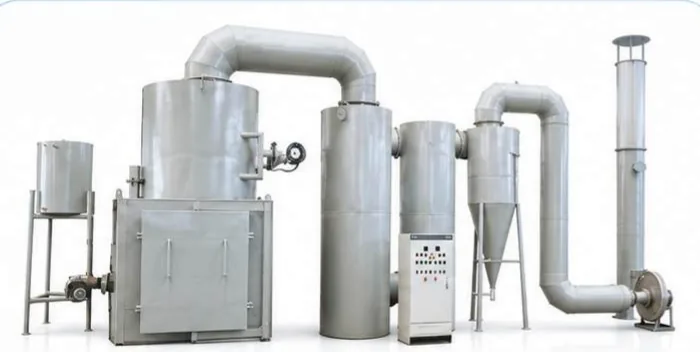
A packaged two-chamber incinerator cannot carry a water-wall boiler, a moving grate and a turbine at 50 kg/h. It performs the same duties with different equipment.
Wide table: scroll sideways to see every column.
| Duty | Large municipal plant | Small packaged plant | What changes |
|---|---|---|---|
| Combustion | Moving grate or fluidised bed, continuous feed | Two-chamber gasification or controlled air, batch feed | Feed control and temperature stability |
| Cooling | Water-wall boiler and economiser | Evaporative quench | No steam; water injected into the gas |
| Nitrogen oxides | Staged combustion, SNCR or SCR | Staged combustion; SNCR if the limit requires it | Reagent system often omitted |
| Acid gases | Semi-dry scrubber plus dry lime | Dry lime filter bricks, or packed wet tower with venturi | Contact time and turndown |
| Mercury and dioxins | Activated carbon injection | Fixed carbon bed or injection | Consumable and contact |
| Particulate | Bag filter, sometimes preceded by an ESP | Cyclone and bag filter | Filter size and cleaning |
| Monitoring | CEMS and periodic dioxin sampling | Periodic sampling and operating records | Evidence route |
| Ash | Bottom ash recovery, fly ash landfill | Manual ash removal, fly ash route | Labour and disposal |
The same duties, answered with different equipment. The last column is where the engineering risk sits.
- Process
- Medical waste is fed through the charging door into the primary combustion chamber according to the loading procedure of the selected model: no more than the rated load per batch, and the door is closed and locked after charging.
- Principle
- Batch charging releases a larger amount of volatiles in a short time. The load should match the model design so as not to exceed the downstream combustion and flue-gas treatment capacity.
The table is not a list of downgrades. Each row is a different answer to the same duty, and some of the answers suit a small site better. A fixed carbon bed is easier to operate than an injection lance; a dry lime brick needs no wastewater route; a quench has no heat-exchange surface to foul. The question is whether the replacement still holds the limit.
The combustion stage: the one that cannot be simplified
The 850 °C and two-second figures are a gas residence time, not a furnace rating. They are measured after the last combustion-air injection, and they assume the gas is mixed and at temperature for the whole period. In a small batch unit, both assumptions are under strain.
The first strain is the feed. A batch charge volatilises unevenly: a wet or high-plastic load releases its volatiles in a burst, and the secondary chamber sees a gas flow and a heating value that change within minutes. The chamber must be sized on the peak gas volume at temperature, not on the nominal kilograms per hour, and the secondary burner must hold the set point through the burst.
The second strain is heat loss. A small chamber has more surface area per cubic metre of gas than a large one, so it loses heat faster to the shell and needs more insulation and a larger refractory mass to hold temperature between charges. A secondary chamber below its set point is one of the first things to check when a small unit emits visible smoke.
The third strain is mixing. A small chamber can short-circuit: gas can pass from the inlet to the outlet without spending the full residence time in the hot zone. The geometry, the air injection points and the baffling decide whether the two seconds are real or nominal.
What to specify: the secondary chamber volume at the design gas flow and temperature; the burner capacity and turndown; the temperature mapping used to prove the residence time; an interlock that stops charging when the chamber is below temperature; and a CO or oxygen trim that shows the combustion is complete rather than merely hot.
The cooling stage: crossing the window in a smaller gas stream
Between the chamber and the filter, the gas passes through the range in which dioxins can re-form on fly ash. The band usually quoted is roughly 200 to 400 °C. The design aim is not a particular outlet temperature; it is to cross the band quickly and not let the gas sit in it.
A large plant crosses the band in a boiler, and the boiler is there for the heat. A small plant usually crosses it in an evaporative quench: water is sprayed into the gas and the latent heat of evaporation takes the temperature down without a heat-exchange surface. The small gas flow helps, because there is less thermal inertia and the water can act quickly. The batch feed works against it, because the gas flow and temperature are not steady.
A quench is a wet vessel. The water has to be supplied and treated, the gas leaves saturated, and the acid gases make the condensate acidic. The tower, the sprays and the duct downstream have to be chosen for that service. Where a small plant does recover heat, the gas spends longer in the band; the design has to say how it crosses the band, not only how much heat it recovers.
What to specify: the cooling rate through the band, not only the inlet and outlet temperatures; the quench response time to a step change in load; the gas temperature at the filter inlet; and the material of the duct between the quench and the filter.
Acid removal, adsorption and filtration at small scale
The three stages behind the quench are the ones most often compressed in a small package, and each compression has a cost.
Acid gas removal. A dry train passes the gas through lime-based filter bricks or injects a solid sorbent into the duct. It needs no water and produces no liquid effluent, which is why it suits remote sites. The constraints are contact time, reagent utilisation and the fact that the brick or the sorbent is a consumable. A wet train, a packed tower or a venturi, removes more acid gas per unit of reagent but needs water, a reagent supply, a blowdown route and corrosion-resistant materials. A site without a wastewater route should not be given a wet train by default.
Adsorption. Mercury leaves the furnace as a vapour, and dioxins can survive the chamber in small quantities. Both are captured on carbon. A fixed carbon bed is easy to control and to monitor; an injection system doses powdered carbon into the duct and relies on the bag filter cake to hold it. The injection rate is a running cost, and the spent carbon leaves with the ash. Temperature matters in both arrangements: adsorption is weaker when the gas is hot, and a gas that is too cold carries wet, sticky dust into the filter.
Filtration. The bag filter removes particulate and the metals that ride on it. In a dry or semi-dry train it is also a fixed bed: the sorbent and the reaction products sit in the cake, and the gas continues to react as it passes through. The constraint is the bag material’s maximum continuous temperature, and the quench or scrubber upstream has to deliver the gas below it. A cyclone ahead of the bag filter takes the coarse dust and protects the bags, but it is not a substitute for the filter.
The small-plant problem is not usually a missing stage. It is the short duct between the stages: too little length for the reagent to mix, too little residence time for the carbon to contact, and a filter that is asked to do chemistry and separation at the same time. The design has to give each stage its own length, or accept that the stage is only nominal.
Where a small plant loses the standard
The failures recorded for batch incinerators are operational more than mechanical. Operating guidance for dual-chamber units lists the same set: high fuel consumption when the waste is wet or the air is excessive; fused ash and clinker when air ports are blocked and local bed temperatures rise; visible emissions when the secondary chamber is below set point, when air leaks in through distorted doors or seals, when the draft is wrong, or when the charge is too large for the unit.
Two of those are worth translating into design terms. Air ingress through a warped door or a corroded shell is a small-plant problem because the shell is thin and the door is opened every cycle; the seals and the door frame are part of the emission control, not part of the casing. And a cold secondary chamber is often a burner or interlock problem, not a waste problem: the unit should not be charging waste while the chamber is below its set point.
The gas train adds its own failure list: a quench that is slow to respond, a bag filter that is wet or cold, a carbon bed that has passed its replacement interval, a lime brick that has been in service beyond its acid load. None of these shows up as a mechanical breakdown. They show up at the stack, and they show up late.
The limit does not shrink with the plant
The emission limit is written at the stack, and it does not become looser because the plant is small. Under the EU Industrial Emissions Directive, waste incineration plants are held to 0.1 ng TEQ/Nm³ for dioxins and furans, with daily averages for the other parameters and the 850 °C and two-second combustion condition. China’s standards set 0.5 ng TEQ/m³ for dedicated medical-waste incineration (GB 39707-2020) and 0.1 ng TEQ/m³ for municipal solid waste incineration (GB 18485-2014).
What can change with size is the monitoring route. The IED requires continuous measurement of NOx, CO, dust, TOC, HCl, HF and SO2, plus at least two measurements a year of heavy metals and dioxins, and one every three months for the first year. The competent authority may reduce some of that for a small plant: periodic rather than continuous measurement of HCl, HF and SO2 where the operator can prove the emissions cannot exceed the limit, or periodic NOx measurement for existing plants below 6 t/h under the same proof. The limit does not move. The evidence burden moves from a continuous analyser to periodic sampling and operating records.
That distinction is the practical answer to the question of how a small plant meets the standard. It meets the same limit with the same unit operations, and it proves compliance through a monitoring plan proportionate to its size and risk. A small plant that cannot produce the sampling records, the temperature records and the ash route is not compliant, even if its furnace runs at 850 °C.
What cannot be miniaturised
Four things do not shrink with the furnace.
- Continuous monitoring. A CEMS shelter, analysers, calibration gases and maintenance are largely fixed costs. On a small unit they can cost more than the furnace. Where the permit requires CEMS, that cost belongs in the project budget from the first estimate.
- Dioxin and heavy-metal sampling. The measurement is a sampling train and a laboratory analysis, not a sensor. The frequency may be lower for a small plant, but the method and the laboratory are the same.
- Ash. Bottom ash and fly ash are produced at any size. The fly ash carries the metals and the dioxins that were removed from the gas, and it needs a tested disposal route. A small plant without an ash route has moved the problem, not solved it.
- Operator skill. A batch unit depends on a person watching temperatures, charging rates and air. The smaller the plant, the less automation there is to cover for the person, and the more the result depends on training and records.
The WHO’s 2019 overview puts the economic threshold for a full high-technology incineration plant at 100,000 tonnes a year. That figure is about a central plant with a complete train and continuous monitoring. It does not mean a small plant cannot meet a limit; it means the fixed costs of the full high-technology route are hard to carry at small scale. The answer is to match the monitoring and the gas train to the limit and the site, not to pretend the fixed costs are absent.
A specification checklist for a small train
- Is the waste characterised by calorific value, moisture, chlorine and plastics, not only by kilograms per day?
- Is the emission standard named, with the averaging period for each parameter?
- Is the secondary chamber sized on peak gas flow at temperature, and is the residence time proved by a temperature map rather than by a drawing?
- Is the quench sized for the fastest load change, and is the filter inlet temperature stated?
- Does every pollutant group have a stage that answers it, and does each stage have the contact time it needs?
- Is the bag material rated for the gas temperature and chemistry at its inlet?
- Is the carbon or lime inventory a consumable with a replacement rule based on gas volume and acid load?
- Is there an ash route, with a receiving facility named?
- Is the monitoring plan proportionate to the permit, and does the site have the records to prove it?
- Is there one named operator, with training and authority to stop charging?
From a standard to a configuration
A small plant is not a miniature large plant. It is a different plant that performs the same unit operations with different equipment and a different evidence route. The stages that decide compliance are still combustion, cooling, acid removal, adsorption and filtration; the stages that decide whether the plant can prove compliance are monitoring, ash and the operator.
The incinerator pages set out what each purification configuration contains, and the emissions chart sets out the limits the train has to meet, parameter by parameter. The quench window, carbon injection and NOx articles cover those stages in more detail, and the cost comparison sets out what the choice costs per tonne. The configuration, the reagent consumption and the filter for your waste are confirmed with us against the waste composition and the standard that applies.
This page follows the stages; the country limits themselves are compared with their original reference conditions in medical waste incinerator emission standards by country, and the full train is covered in flue gas treatment in an incinerator. The certificate entries are listed on our certificates page, the brochure is available as the incinerator brochure (PDF), and a first capacity estimate can be run on the incinerator capacity calculator.