
Selecting sludge dewatering equipment.
Dewatering turns surplus sludge into a handleable cake. The choice of press follows the sludge, the cake target and the space you have to work in.
Where sludge dewatering sits in the process
- 1Biological treatment produces sludge — the biology grows solids as it removes organic matter.
- 2Thickening and conditioning — the sludge is concentrated before dewatering so the dewatering unit is not oversized, and polymer conditioning builds the floc the dewatering stage needs.
- 3Even distribution — the conditioned sludge is spread uniformly across the belt, the cloth or the chamber, because an uneven feed gives an uneven cake and an uneven dewatering result.
- 4Drainage and pre-pressing — the free water leaves under gravity, or under a light pre-press, ahead of the main separation stage.
- 5Main separation — the chosen route sets the mechanism: pressing between rollers, batch pressure in closed chambers, compression by a slow screw, or vacuum under a filter cloth. A high-pressure stage belongs to a specific deep-dewatering route; it is not part of the standard CXSW belt press configuration.
- 6Filtrate and cake — the filtrate is collected and returned to the head of the plant or treated, and the cake goes to handling, with a drying stage after the press where the disposal route needs a drier product. Not every machine passes through every step: a screw press, for example, combines thickening and pressing in one pass.
Equipment types we can discuss
Each type suits different sludges and cake targets.
Belt filter press
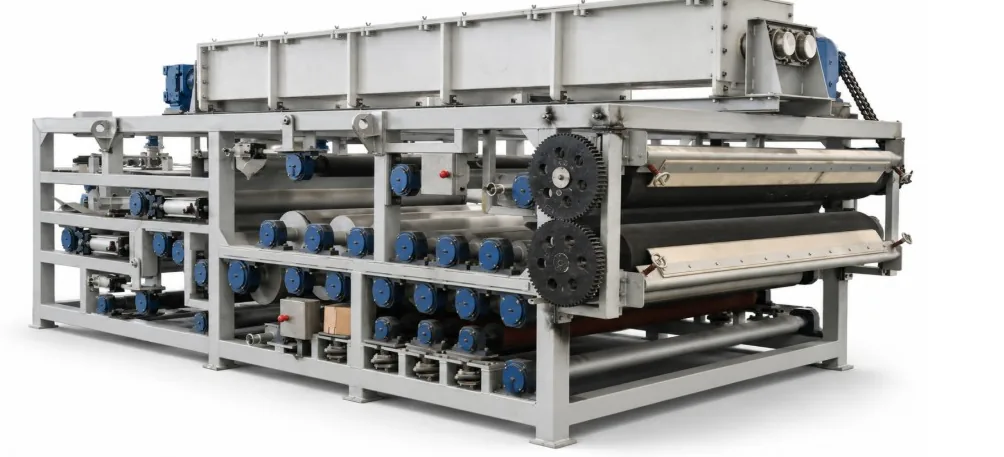
sludge is squeezed between moving belts as water drains under gravity and then under pressure, which gives a continuous process with a steady cake and a visible dewatering path.
Plate-and-frame filter press
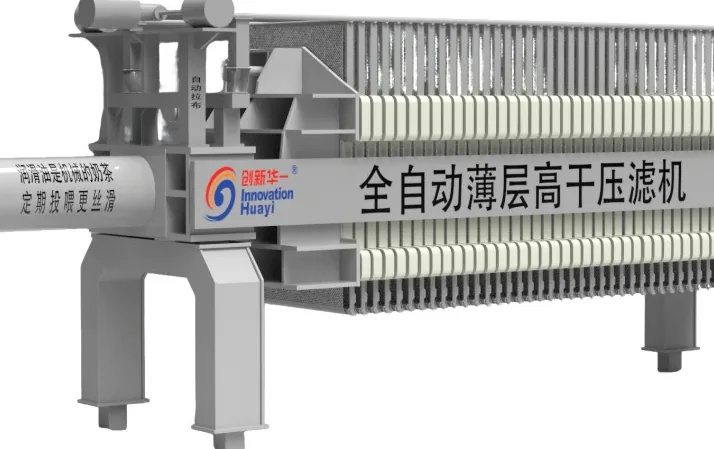
sludge is pumped into closed chambers and pressed to a firm cake in batches, which suits duties that want a drier cake and can work to a batch cycle.
Screw press and multi-belt press
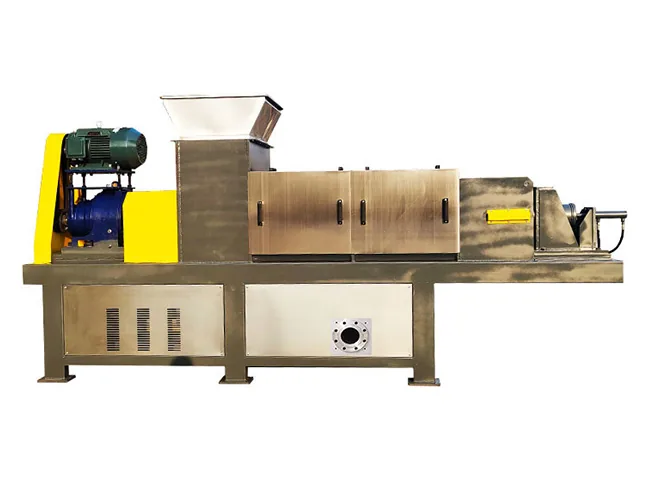
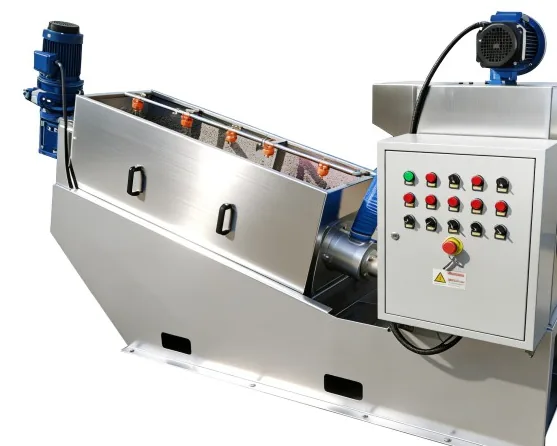
a slowly turning screw or a stack of belts compacts the sludge continuously, which suits small and medium duties where little wash water and low noise matter.
Vacuum belt filter
a cake forms on a moving filter cloth and the vacuum beneath it draws the filtrate through, which suits fine slurries and duties where the cake has to be washed as well as dewatered.
Centrifuge
high-speed rotation separates solids from water by density; it is enclosed and compact but carries the highest power and noise of the machines compared below. Shown for comparison — we do not supply centrifuges.
How to choose
The values for each project are confirmed against the actual sludge and site.
| Sludge type and concentration | Municipal, livestock, slaughtering, food, chemical and pharmaceutical, and mining sludges |
|---|---|
| Required cake dryness | Set by the cake disposal or reuse route; confirmed for each project. |
| Footprint available | Set by the site layout; confirmed for each project. |
| Chemical conditioning | Polymer dosing system, mounted on the dewatering skid |
| Operator level | Unattended — automated one-push-button start and stop |
| Throughput | 4–50 m³/h across the belt filter press range |
Centrifuge vs belt press vs screw press
These three machines are the ones most often quoted against each other for the same duty. The comparison below sets out what each one does by construction. The centrifuge is included as a reference: we do not supply centrifuges, so it is here to be compared against, not to be offered.
| Aspect | Centrifuge | Belt filter press | Screw press |
|---|---|---|---|
| How it separates | Solids are thrown to the bowl wall by centrifugal force, and the scroll conveys them out | Water drains under gravity on the belt, then the sludge is pressed between rollers | A slowly turning screw compacts the sludge against a stack of rings or plates |
| Cake dryness | Set by the sludge and by its conditioning more than by the machine type, so an indicative figure for any of the three has to come from a test on the sludge in hand | As at left — the dryness reached depends on the sludge and on how well it is conditioned | As at left — the dryness reached depends on the sludge and on how well it is conditioned |
| Footprint and enclosure | Fully enclosed rotating machine, compact, and it can stand outdoors | The largest footprint of the three, and it usually needs a cover, wash water and drainage | Compact, and it can run unattended with little wash water |
| Power and noise | Highest of the three: a bowl turning at high speed carries the largest installed power and the most noise | The middle of the three | Lowest: a slow-turning screw, so little power and little noise |
| Conditioning chemical | Sensitive to polymer conditioning; the floc has to survive very high shear | Needs conditioning, and the floc has to stay intact under roller pressure | Needs conditioning, and tolerates a floc that is less strong than the belt press requires |
| Wear parts and service | Bowl and scroll wear, balance and specialist repair; the machine is not normally serviced on site by the plant operator | Filter belts, rollers and wash nozzles — wear parts that are replaced on site | Screw flights and ring plates; slow speed, so wear is gradual and the work is within a plant technician's reach |
| Where each one suits | Large flows where a compact, enclosed machine and the lowest wash-water demand matter most | Municipal and mixed sludges where the duty is steady and a firm cake at moderate throughput is the target | Small and medium duties, unattended sites, and sludges that suit a slow, low-noise machine |
| Supply status | Reference comparison only — we do not supply centrifuges | Supplied, in the CXSW belt filter press range | Supplied, in the CXDL screw press range |
The plate-and-frame filter press is the fourth option on this page and works in batches rather than continuously, and the vacuum belt filter is a further continuous option where a fine slurry also needs its cake washed. Cake dryness, throughput and polymer demand for a given sludge are confirmed with us for your sludge rather than read from this table.
Selection steps
- 1Characterize the sludge — the type, the source, the solids concentration and how it behaves when it is thickened and conditioned.
- 2Set the cake target — the dryness the disposal or reuse route needs, because that target fixes the press type and the conditioning.
- 3Pick the press type — match the continuous or batch machines to the sludge, the cake target, the footprint and the operator attention available.
- 4Size and power the unit — capacity, polymer conditioning, wash water and the power available on site all set the machine and its ancillaries.
- 5Plan the civil works — foundation, drainage and the space needed for cake handling, so the building and the machine are designed together.
What to send us
- Sludge type and source.
- Dry solids content of the sludge.
- Daily sludge volume.
- Target cake dryness.
- Footprint available.
- Discharge and disposal route for the cake.
- Conditioning chemicals available on site, and the polymer dosing arrangement preferred.
- Operating pattern — hours per day and whether the unit runs attended or unattended.
- Where cake washing is being considered — the slurry analysis with the soluble component to be displaced, the residual target for the cake, the throughput and the cake thickness aimed at, the wash-water conditions available, and where the wash liquor should go.
Selection input template
Download the editable Excel template for this page, fill in your site data, and send it back to us.
Questions we answer on dewatering projects
Which press fits which sludge?
Belt filter presses run continuously and suit municipal and mixed sludges. Screw presses also run continuously and take a small footprint. Plate-and-frame presses work in batches and generally produce a drier cake. The final choice follows the sludge, the cake target, the space and the operating pattern rather than the machine type alone.
Why thicken the sludge before dewatering?
Thickening raises the solids concentration before the sludge reaches the press, so the dewatering unit, the polymer dose and the transport are not paying to move water that could have been removed more cheaply upstream. The dewatering machine is sized on the solids duty, but it is fed a volume, and that volume follows the thickening step.
What cake dryness can be reached?
It depends on the sludge, the conditioning and the machine. Our project records include an ultra-high-pressure belt press taking sludge from 80% moisture to 65%, with low-temperature drying afterwards taking it below 40%; several projects report below 60%. Those are results recorded on those projects, not a guaranteed figure for another sludge.
Continuous or batch operation?
Belt filter presses and screw presses run continuously, which suits a steady sludge flow and limited operator attention. Plate-and-frame presses run in batches, filling and pressing chamber by chamber. The choice follows the shift pattern and the daily sludge volume — a continuous machine on a small batch wastes capacity, and a batch machine on a steady flow needs buffer storage.
What data do you need?
The sludge type and where it comes from, its dry solids content, the daily sludge volume, the cake dryness the disposal or reuse route requires, the footprint available, and where the cake will go. Those inputs decide the press type, the conditioning and the size of the unit.
When does cake washing make sense?
Washing earns its place when the liquor held in the cake carries a soluble component worth recovering, when the cake has a purity target to meet, or when the disposal route classes the residue it holds. Where none of these applies, washing can add wash-water demand and dilute the mother liquor without adding process value. The wash duty is set against a residual target and verified by sampling the wash liquor for the component being displaced — not by a fixed time, and not by the cake looking clean. Engineers often discuss the duty in terms of cake void volumes (bed volumes) and counter-current stages, and we use the same language when we evaluate a project, but the figures are fixed per project rather than quoted as a general wash ratio. Within the equipment range covered on this page, the vacuum belt filter is the continuous route for that wash duty.