
On this page
A campus or dormitory site seldom has a single water problem. It has several, and they surface in different places: sediment at one tap, a smell in one building, scale on the kitchen fittings, low pressure on the top floor. Treating them as one problem produces a plant that fixes none of them well. The order that works is the order the water travels.
Start where the water enters
A campus usually has more than one source: a municipal supply, a deep well, a surface source, or tanker delivery in the dry season. The first step is to establish which source feeds which building and what its quality is. A deep well with high iron behaves nothing like a municipal supply with intermittent pressure, and a plant sized for one will not fix the other. Take the source water analysis before anything else, and record whether the site blends sources and where the blend happens.
Where a site stores water, the storage is part of the source. A tank that is drawn down and refilled daily behaves differently from one that turns over slowly, and the difference shows up downstream as sediment, biofilm or odour. The tank is not a passive object between the source and the tap; its turnover, its cleaning interval and its inlet and outlet arrangement decide what reaches the building.
Read the tank before the tap
A storage tank does three things to water: it lets solids settle, it lets chlorine decay, and it gives biofilm a surface. A complaint about sediment at the tap is often a tank cleaning and turnover problem rather than a treatment problem. A complaint about taste or odour can be biological growth in the tank or in the pipework. Inspecting the tank is cheaper than adding a process to hide the symptom, and it is the step most often skipped.
Then separate the symptoms
Wide table: scroll sideways to see every column.
| What the site reports | What it usually points to | What to check first |
|---|---|---|
| Sediment or grit at the tap | Solids entering from the source or the network | Source turbidity, tank sediment, strainer condition |
| Brown or rusty water after a stoppage | Iron in the source, or corrosion in the pipework | Iron and manganese in the source analysis; pipe material and age |
| Taste or odour, worse in the afternoon | Biofilm in the tank or the distribution, or chlorine decay | Tank turnover and cleaning; free chlorine at the far end |
| Cloudy water in the wet season | Turbidity carried in from the source | Source turbidity record across the season, not one sample |
| Pressure loss at upper floors | Supply pressure, not water quality | Pump curve, tank level and pipe sizing |
| Staining or scale on fittings | Hardness or dissolved solids | Hardness, alkalinity and TDS in the source analysis |
The symptom names the layer. The layer decides whether the job is filtration, disinfection, storage operation or plumbing.
Match the process to the layer
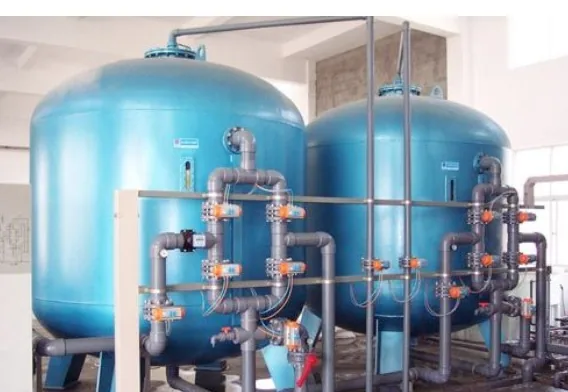
Once the layer is known, the process follows. Turbidity and sediment are a filtration question: multimedia or sand filtration, with cartridge filtration as a polishing step where the target is tight. Iron and manganese are an oxidation and filtration question, and the oxidation step has to be chosen against the measured concentrations rather than a generic dose. Taste and odour from biofilm are a disinfection and storage-operation question first; adding carbon without fixing turnover usually moves the problem rather than removing it. Hardness and scale are a softening question, and softening is expensive to operate, so it is justified by the cost of the scale, not by the look of the fittings.
Two layers can be wrong at once. A site with an iron-bearing well and a slow-turnover tank can show both brown water and odour, and fixing one will not remove the other. That is why the diagnosis runs in order and the evidence is recorded layer by layer, with the building and the time of day attached to each complaint.
What changes when the site is a dormitory
- Occupancy is seasonal and concentrated: the peak is term time, and the daily peak is early morning and evening, so storage and the pump set are sized on the peak hour, not the average day.
- The building may be one of several on the same plot. Under the 2024 building effluent notice a group of buildings on the same plot is assessed as one building, so a dormitory’s sewage and the campus sewage are one discharge question, not two.
- A dormitory under 50 rooms falls in class ง of that notice. Whether it is a controlled pollution source is a question for the local authority, so the discharge route is established early rather than assumed.
What we need to scope a campus water job
- Every source on the site, and which buildings each one feeds.
- A source water analysis: turbidity, colour, iron, manganese, hardness, alkalinity, TDS, pH and a bacteriological result.
- Tank volume, turnover, cleaning interval and the condition inside the tank.
- The complaints, each with its building and the time of day or season it appears.
- Peak occupancy and peak-hour demand, not only the average day.
- The target: drinking water, washing and showers, kitchen use or irrigation, and the standard each one has to meet.
- Power supply, plant room space, and access for delivering and replacing filter media.
What we supply, and what stays on site
For a campus water job we design the process and supply the treatment equipment: filtration vessels and media, dosing and disinfection sets, and the controls. The plant room, the pipework to and from the units, the electrical supply, the storage tank works and the operating permits stay with the site and its contractor. The split is written into the quotation, so the interface is fixed before the order rather than on site.
Questions we answer on campus water projects
The water is clear but smells. Do we need a filter? Probably not first. A smell with clear water usually points to biofilm in the tank or the distribution, or to chlorine decay at the far end. Check turnover and free chlorine before adding filtration.
Can one plant serve the whole campus? It can, but only after the sources and the buildings they feed are mapped. One plant on a blended supply is a different design from two plants on two sources, and the choice follows the pipework, not the preference.
The dormitory is only occupied in term time. Does that change the design? Yes. Storage and disinfection have to be sized for the peak term-time demand and also for the low-flow period when the tank turns over slowly, which is when biofilm and stagnation problems appear.
Is the campus sewage part of this? It is a separate question with its own standard. The 2024 building notice classes a group of buildings on one plot as one building for effluent purposes, so the sewage side is assessed on the whole plot even when the water side is solved building by building.