
Sludge scrapers.
Drive bridges that travel a circular sedimentation tank and move the settled sludge to the discharge point, so a clarifier empties its floor continuously instead of being taken out of service to be cleaned.
What a sludge scraper is, and what the site still does
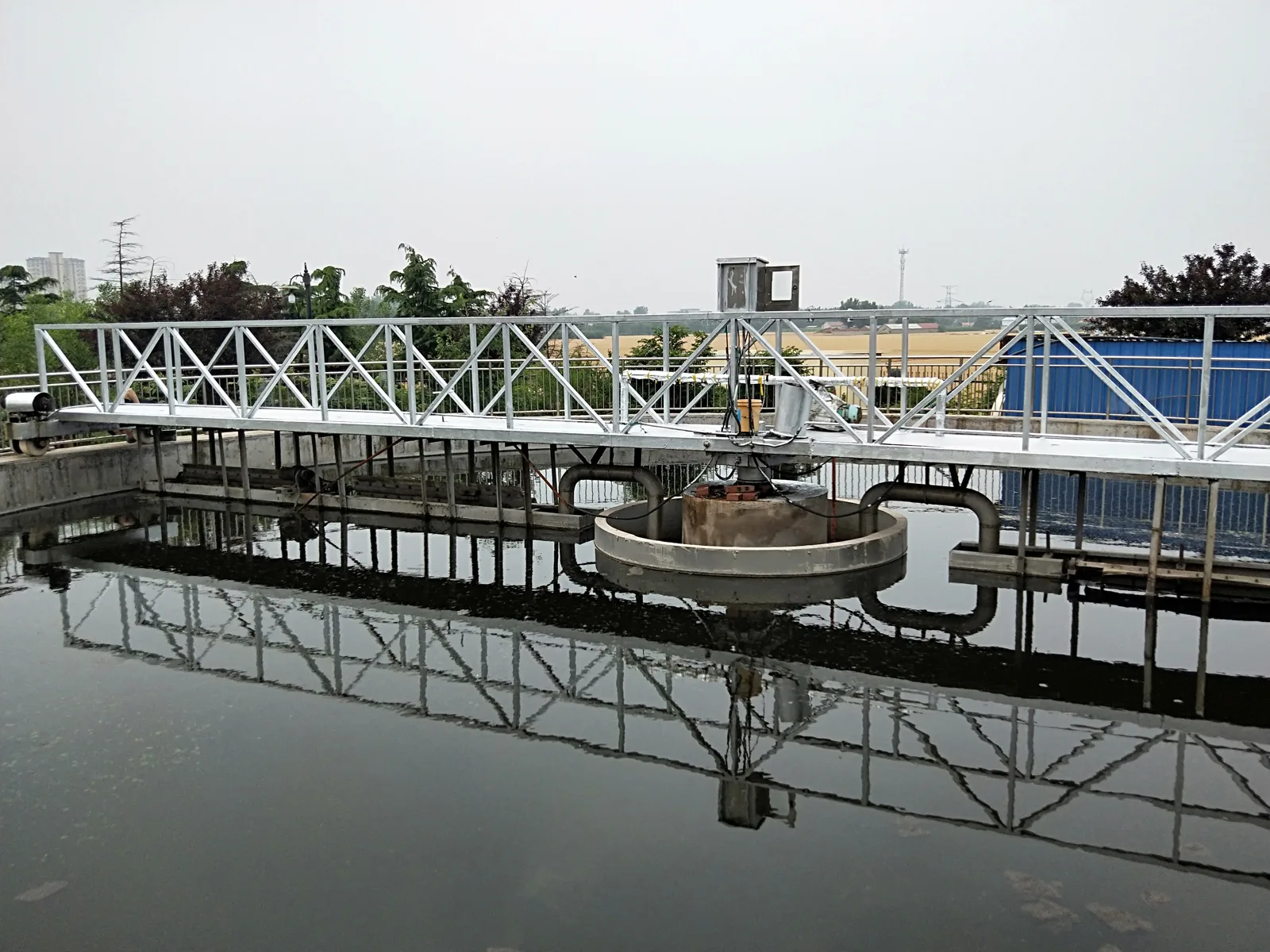
A sludge scraper is a bridge that spans a circular clarifier, with scraper arms and blades reaching down to the floor; as the bridge travels, the settled sludge is driven to the discharge point at the centre and drawn off, and the clarified water is taken from the upper layer. The bridge is built as a truss, and the parts that contact the water are made in stainless steel. The unit is assembled and tested at our factory before shipment, so on site the civil tank and its rim rail, the foundation, the inlet and outlet pipework to our flanges, the power cable, and the lifting and placement are site work.
A circular clarifier is scraped either from a drive on a central column or from a drive that runs on the tank rim. The CXZB range covers the peripheral drive: the bridge is carried around the rim on its own drive units, so no central support structure stands inside the tank and the whole floor is reachable. The published range covers tank diameters from 20 to 100 m.
A centre-drive machine suits a different tank and a different structural arrangement. The choice follows the tank that exists or is planned, not the other way round. Where the solids are light or oily and refuse to settle, dissolved air flotation is the stage to compare, and the design influent quality chart sets out the feed data either choice needs.
How drive torque is sized
Drive torque is the number that decides whether a scraper can move the sludge it meets. It has to overcome the rolling resistance of the bridge, the resistance of the sludge being pushed to the outlet, and the traction at the drive wheels, with a margin for the heaviest sludge and the coldest water. The motor power in the table is not the drive torque: the same motor can be geared to a different wheel speed and a different torque.
The torque is sized per project from the bridge weight, the sludge load, the tank diameter and the wheel arrangement. Those inputs come from the tank design and the sludge duty, and our engineering team confirms the drive selection against them. The brochure does not publish a torque figure for the CXZB range.
Bring these inputs to sizing
The tank diameter, side depth, bridge span, sludge load and wheel arrangement are what the drive selection needs; the torque follows from them for the project.
Sludge collection, discharge and concentration
The scraper blades drive the settled sludge from the rim to the centre, where a sludge collection tank and the discharge device take it out of the clarifier. The concentration that can be drawn and the volume produced depend on the feed solids and the process, and they are confirmed for the project. The sludge dewatering range takes the sludge on to a handleable cake.
Scum and floating matter are collected by the same bridge arrangement, so the unit handles both the floor sludge and the surface scum rather than only one of them.
Materials, bridge load and civil interface
Water-contact parts are stainless steel; the bridge structure is fabricated and painted. The bridge dead load and live load, the wheel loads and the embedded parts have to reach the civil designer so that the tank wall, the rim rail and the foundation are built for them. Those loads are confirmed on the order drawing.
The civil tank, the rim rail, the foundation, the inlet and outlet pipework and the power supply are site work. The interface drawing fixes where our steel ends and the civil work begins, and the selection and sizing guide takes the site conditions into the choice.
Installation, commissioning and maintenance
Installation sets the bridge on the rim, aligns the drive units and the scraper blades to the floor profile, and runs the machine through its travel before the tank is put into service. Commissioning checks the travel, the blade clearance, the drive current and the sludge discharge. Maintenance is mostly inspection: the drive units, the wheels, the blades and the collection tank.
A retrofit replaces a bridge and drive on a tank that is already built. The survey has to confirm the rim geometry and the floor profile before the new bridge is made.
What we supply and what stays on site
In our supply sit the bridge, the peripheral drive units, the scraper arms and blades, the sludge collection tank, the discharge device and the electrical equipment. The civil tank, the rim rail, the foundation, the inlet and outlet pipework, the power cable, the lifting and the placement are site work. We are not a turnkey civil contractor.
The transport envelope is confirmed with each order against the packed dimensions, the route and the port of discharge.
Acceptance is written into the contract: factory acceptance tests before shipment, site acceptance tests after installation, and a run-through at the sludge load the tank is designed for, with the drive current, the blade clearance and the sludge discharge agreed for the project, and anything that fails rectified and retested. Acceptance records are project documents; when you compare quotations, ask for the acceptance section of the contract.
What the CXZB table is, and what is project-confirmed
The CXZB table on this page is the same six-model table as the sedimentation hub, reproduced from our 2026.6 catalogue. Tank diameter, side depth, peripheral speed and motor power are catalogue values; they are not a first-party performance test and they do not fix the drive torque.
Drive torque, bridge load, embedded parts and any project reference are confirmed for the duty. The sedimentation and clarification hub sets the scraper against the inclined tube settler and the other separation stages.
Factory footage
CXZB peripheral-drive sludge scraper
The CXZB scraper is made up of the bridge, the cut-off walls, the transmission system, the water tank, the sludge collection tank, the sludge discharge device and the electrical equipment. Water to be treated enters the tank through central pipes and flows out into the sedimentation basin; clean water in the upper layer is discharged directly, while the sludge on the floor is driven to the collection tank by the travelling bridge and then discharged. The bridge runs on its own peripheral drive units, so the tank interior stays clear, and the scraper blades are arranged to keep the floor swept from the rim to the centre. The bridge can be customised to suit the tank it has to fit and the duty it has to do.
| Model | Tank diameter (m) | Tank side depth (m) | Peripheral speed (m/min) | Motor power (kW) |
|---|---|---|---|---|
| CXZB-20 | 20 | 3–5.6 | 1.6 | 0.37 × 2 |
| CXZB-30 | 30 | 3–5.6 | 1.8 | 0.55 × 2 |
| CXZB-45 | 45 | 3–5.6 | 2.2 | 0.75 × 2 |
| CXZB-55 | 55 | 3–5.6 | 2.4 | 0.75 × 2 |
| CXZB-60 | 60 | 3–5.6 | 2.6 | 1.5 × 2 |
| CXZB-100 | 100 | 3–5.6 | 2.8 | 2.2 × 2 |
This is the same six-model CXZB table as the sedimentation hub. Dimensions are reference values reproduced from our 2026.6 catalogue and are approximate. Final dimensions and weights are confirmed against the site conditions and the actual build.
Bridge, drive and floor equipment
The working parts of a scraper are the bridge, the drive and what reaches the floor. The bridge is fabricated as a truss so that it spans the tank with the walkway and handrail on top and the scraper arms below; the drive units run on the tank rim or on a centre column, and the drive is sized to move the bridge and the sludge load it pushes at the same time. The scraper arms are fitted with blades or squeegees that follow the tank floor profile, and the same bridge carries the scum and sludge collection equipment. Steel that contacts water is stainless; the rest of the structure is fabricated and painted at our factory.