Chemical and advanced treatment.
Oxidation and dosing stages for wastewater that biology cannot break down on its own — Fenton reaction, iron-carbon micro-electrolysis and automatic polymer preparation.
What a chemical treatment stage is, and what the site still does
Chemical and advanced treatment is the stage that breaks down what the biology cannot. The organics in these streams resist biodegradation, so the COD stays high through the biological train, the colour carries over and long-chain compounds reach the effluent; oxidation and micro-electrolysis attack that fraction instead of passing it on. Fenton oxidation uses hydrogen peroxide with a ferrous catalyst to break down part of the organic load and raise the BOD to COD ratio; iron-carbon micro-electrolysis breaks long chains and opens rings in an acidic band ahead of the biological stage; and automatic polymer preparation makes and meters the flocculant the dewatering stage needs. The stage runs ahead of the biological train as pretreatment, or after it as polishing. The reaction and dosing equipment is assembled and tested at our factory before shipment, so on site the foundation and civil works, the reagent storage and its bunding, the ventilation and gas detection where the risk assessment calls for them, the power supply to the control panel, the inlet and outlet tie-ins, the drainage and the permits are site work.
When oxidation or micro-electrolysis is the right stage, and when it is not
The stage earns its place when the organics resist biodegradation: the COD stays high through the biological train, the colour carries over, and the BOD to COD ratio is too low for the biology to finish the job. That is the case for much refractory chemical, pharmaceutical, dyeing and electroplating wastewater and for landfill leachate, and it is why the units are placed either ahead of the biological stage as pretreatment or after it as polishing.
It is not the right answer for every stream. A high chloride or salinity load scavenges the oxidant and attacks the wetted material; free oil, grease and a high suspended-solids load consume reagent and foul the bed; a strongly buffered water consumes the acid the reaction needs; and a high halogenated or nitrogenous load can shift the by-products rather than remove them. Where the discharge standard is already met by biology, or the operator cannot handle reagents and sludge, a purely biological train is the better value. Where the water is not characterised, a bench test and then a pilot come before any promise; the COD to BOD ratio is the first thing to read, and the Fenton oxidation cost boundary explains when the reaction pays.
The reagent dose is measured, not selected from a table
The Fenton stage uses hydrogen peroxide as the oxidant, a ferrous salt as the catalyst and an acid or base to hold the pH band. What governs the dose is the COD to be destroyed, the share of it that is refractory, the peroxide demand of the water and its buffering, so the dose is measured on the actual water: a bench oxidation test first, then a pilot before the full-scale figure is fixed. We do not quote a universal milligram-per-litre dose for hydrogen peroxide, ferrous salt or acid, because a number copied from a table is not a property of your water. The reagent scheme and the dose are confirmed with our process engineering team from your water analysis.
Micro-electrolysis carries no oxidant dose. The iron-carbon bed works in an acidic band, so the acid addition, the bed loading and the packing replacement are set per project, and the jar test article explains where the neighbouring coagulation stage is dosed. For PAM, the polymer dose comes from a jar test on the actual water or sludge, and the automatic polymer dosing system turns that bench dose into a preparation capacity and a pump setting. In every case the dose is a project test result, not a catalogue constant.
Iron sludge, chemical sludge and who carries the outlet
Fenton oxidation and iron-carbon micro-electrolysis both produce iron sludge, and the coagulation and PAM stages add chemical sludge. The quantity follows the reagent dose and the influent solids, so it is not a fixed kilogram per cubic metre: it is measured with the dose in the bench test and the pilot, and written into the offer as a sludge duty. The sludge is dewatered on the sludge dewatering equipment, which is a separate supply decision.
The legal outlet is not ours to promise. Whether the iron sludge or chemical sludge is classified as hazardous waste is decided by the local authority from a leachate test on the actual sludge, under the rules of the country the plant operates in. The generator of the waste — the operator of the plant — carries the waste responsibility and the disposal permit. We supply the reaction and dewatering equipment and state the sludge duty; we do not take over the disposal route, and we do not describe the process as sludge-free.
Hydrogen peroxide, acid and base, ventilation and interlock boundaries
Hydrogen peroxide is an oxidiser. It is stored vented, inside secondary containment, separated from organics, reducing agents, heat and ignition sources, and handled with the personal protective equipment the supplier safety data sheet specifies; a bulk storage tank is a project item, not part of the standard skid. Acid and base are stored and dosed with their own secondary containment and compatible materials, and they are never plumbed so that they can meet in one line. The pH is controlled by dosing that is interlocked to the flow and to the measured pH, with high and low alarms.
The oxidation reaction releases heat and oxygen, and micro-electrolysis can release hydrogen, so an enclosed room needs ventilation and, where hydrogen can accumulate, explosion protection. The reagent feed, the mixing and the transfer are interlocked: no reagent without flow, level and overflow alarms, and an emergency stop. The stage is run by trained operators under a written procedure, with commissioning and handover, and it is not offered as an unattended plant.
What is in our supply and what stays on site
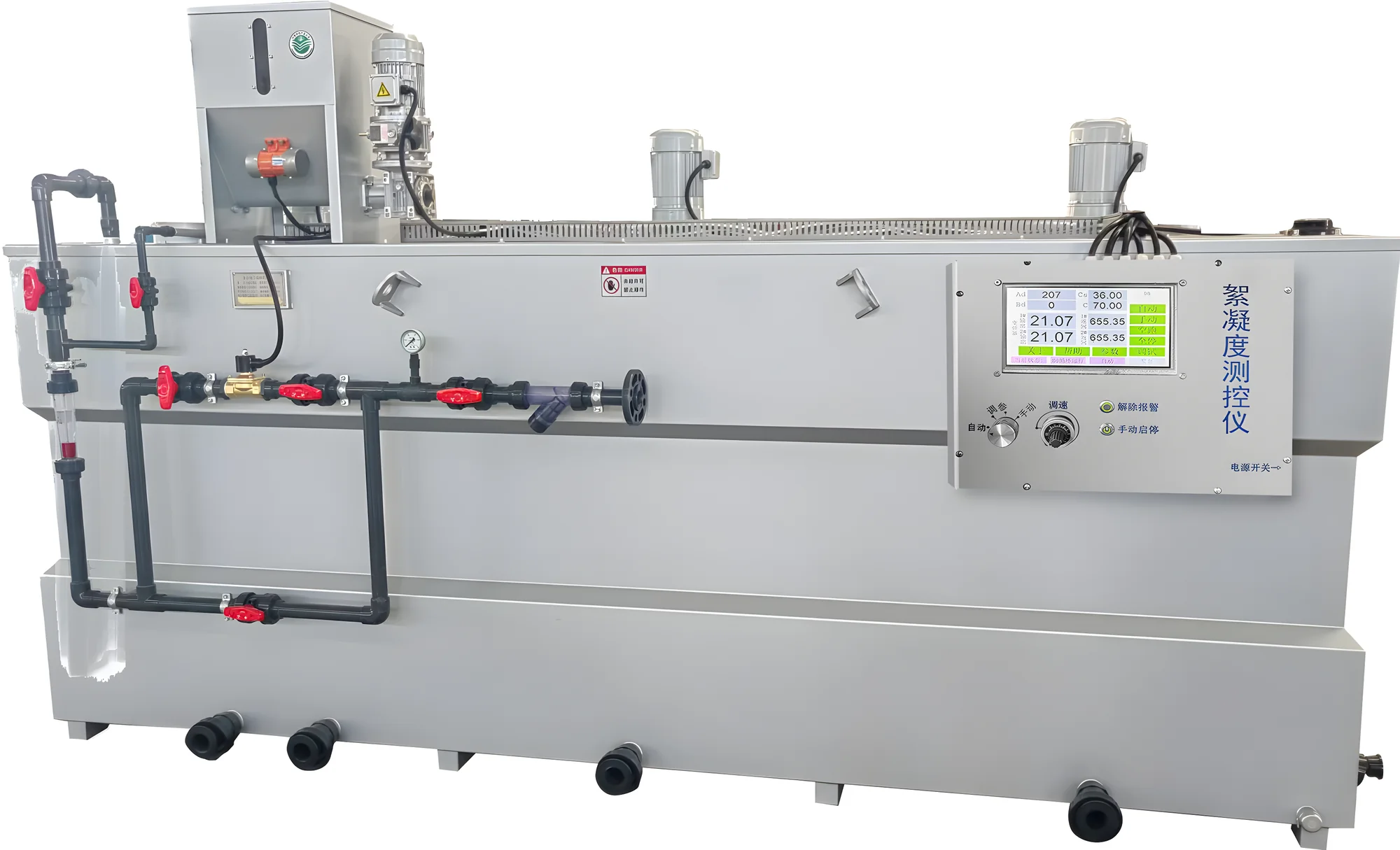
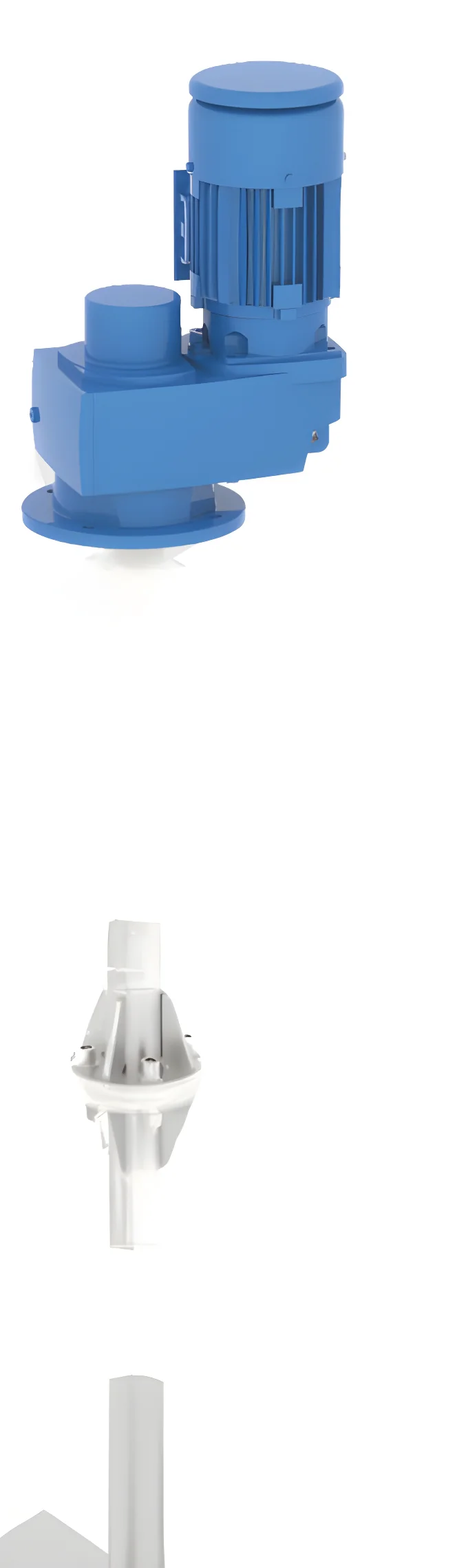
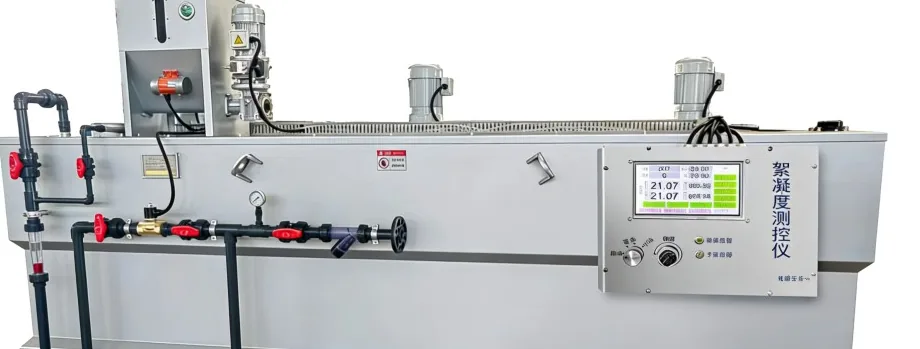
In our supply sit the reactor vessels, the CXWD iron-carbon packing, the CXJY preparation and dosing skid, the metering pumps, the agitators, the local control panel and the pipework inside the skid, assembled and tested at our factory before shipment. The equipment gallery below shows the dosing and agitator units as built.
On site sit the foundation and civil works, the reagent storage and its bunding, the ventilation and gas detection where the risk assessment calls for them, the power supply to the control panel, the inlet and outlet tie-ins, the drainage and the permits. This is not a turnkey building, and the scope line and interface list are fixed in the commercial offer for the project.
A chemical or advanced treatment stage is bought on a result, not on a drawing, and that result is written into the project contract: the effluent against the discharge or reuse target at a defined sampling point — COD, colour and the BOD to COD ratio on the actual water, measured with a stated test method — with the party that carries a missed result named. We do not publish a single removal percentage for the series, because the removal depends on the water: the refractory fraction, the reagent demand, the buffering and the biology that follows all move it. The same boundary applies to every figure on this page: capacity is a catalogue range, while the reagent scheme, the dose, the sludge quantity and the effluent result are confirmed for the project from the design influent quality and the effluent standard, together with the site conditions, and the guarantee, the sampling point and the test method are written into the project contract.
Operation, reagents and utilities
Running the stage consumes reagents — hydrogen peroxide, ferrous salt, acid or base and PAM powder — together with the power for the pumps and agitators, the pH control and the ventilation. Maintenance covers the metering pumps, the agitators and the periodic replacement of the CXWD packing as it is consumed. The operating cost is therefore dominated by the reagent and sludge terms, and both move with the dose.
Operator training, the O&M manual, the spare-parts holding and the response route are project items, agreed in the order and reviewed at handover. The selection and sizing guide shows where this stage sits in a full train.
What drives the running cost
The cost of a chemical stage has four parts: reagent consumption, sludge disposal, power and labour. The reagent and sludge terms are the largest and they move together with the dose, which is why a low reagent price is not the same as a low running cost. We do not publish a price or a cost per cubic metre without a project basis; the offer states the consumables and the dose basis that was confirmed for the water.
The documents behind the numbers
The CXFD reactor table and the CXJY dosing table below are our published catalogue tables, and the CXWD packing specification is the published packing data. For the CXWD reactor itself we publish no fixed model table: the shell diameter and height, the bed loading, the hydraulic retention time, the installed power and the wetted material are fixed per project from the water analysis and the design flow, and confirmed in writing by our process engineering team when the order is placed. Effluent test reports and reference cases are released per project with the customer authorisation; we do not invent a case, a certificate or a performance guarantee.
CXFD Fenton reactor
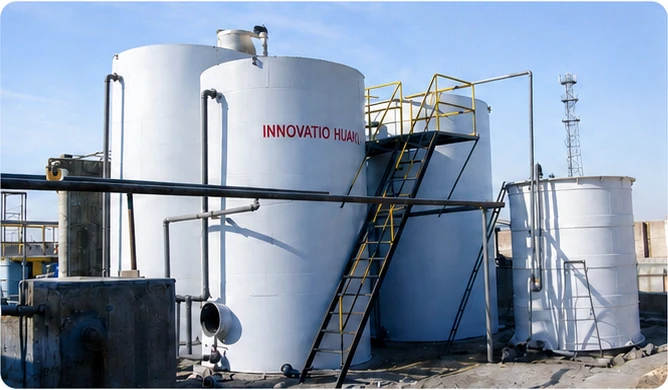
The CXFD Fenton reactor uses a conventional three-tank series configuration. Under acidic conditions, ferrous ions react with hydrogen peroxide to produce hydroxyl radicals, which oxidise refractory organic compounds and improve biodegradability. It is used for high-strength, hard-to-degrade industrial wastewater and landfill leachate. Reagent dosing and project performance are confirmed from the actual water analysis and treatability testing.
| Model | Capacity (m³/h) | Reactor size φ × h (mm) | Hydraulic retention time (h) | Air supply | Net weight (t) | Footprint L × W (m) | Wall thickness (mm) |
|---|---|---|---|---|---|---|---|
| CXFD-1-1 | 1 | 1200 × 1600 | 1 | Yes | 0.5 | 1.4 × 6.0 | 6 |
| CXFD-1-3 | 3 | 1500 × 2400 | 1 | Yes | 0.94 | 4.83 × 8 | 8 |
| CXFD-1-5 | 5 | 1800 × 2600 | 1 | Yes | 1.15 | 7.25 × 8 | 8 |
| CXFD-1-10 | 10 | 2200 × 3500 | 1 | Yes | 1.84 | 15.14 × 8 | 8 |
| CXFD-1-15 | 15 | 2500 × 3700 | 1 | Yes | 2.23 | 20.40 × 8 | 8 |
| CXFD-1-20 | 20 | 3000 × 3500 | 1 | Yes | 2.63 | 25.96 × 8 | 8 |
| CXFD-1-30 | 30 | 3300 × 4200 | 1 | Yes | 3.40 | 37.60 × 8 | 8 |
Values are our standard table; each project is confirmed against the actual build.
CXWD micro-electrolysis reactor
Iron-carbon micro-electrolysis fills the reactor with a mixture of iron scrap and carbon. In acidic wastewater the two form galvanic cells: the iron dissolves and releases nascent Fe²⁺ and hydrogen, and the reactions that follow break long chains and open aromatic rings. The result is a lower COD and colour load and a higher BOD to COD ratio, so the wastewater leaving the reactor is more readily degraded than what entered it. It is normally installed as a pretreatment ahead of the biological stage, where the biology that follows does the rest of the work. The packing specification in the table is our published catalogue data; the reactor itself is engineered per project.
| Packing property | Published value |
|---|---|
| Size and shape | 2 × 2.5 cm, flat-round |
| Crushing strength | 1000 kg/cm² |
| Specific surface area | 1.2 m²/g |
| Bulk density | 1.1 t/m³ |
| Void ratio | ≥65% |
| Packaging | 25 kg/bag |
| Composition | Iron powder ≥75%, fine coke ≥17%, metal catalyst ≥5%, activator ≥2% |
The packing values above are catalogue reference data. For the reactor itself, the shell diameter and height, the bed loading, the hydraulic retention time, the installed power and the wetted material are not a fixed catalogue table: each is fixed per project from the water analysis (COD, pH, salinity and suspended solids) and the design flow, and confirmed in writing by our process engineering team when the order is placed.
CXJY automatic PAM dosing machine
The automatic PAM dosing machine prepares and doses polyacrylamide on site. Powder is wetted and mixed to a working solution in the preparation chamber, held in the maturation tank until it reaches its working state, and metered into the process by a dosing pump, so the flocculant is freshly made rather than mixed by hand. The standard range covers the three preparation capacities listed in the table — 1000, 3000 and 4000 L/h of working solution. Three figures are easily confused: the preparation capacity in L/h is how much solution the machine can make per hour, the polymer consumption in kg/h follows the dose the duty needs, and the metering pump rate in L/h is set to deliver that dose. For sludge dewatering the dose is usually fixed per tonne of dry solids, so the polymer consumption follows the dry-solids load, not only the liquid flow. The dose itself comes from jar testing on the actual water or sludge; the machine is set to reproduce the confirmed dose, routine verification checks the delivered dose, and the jar test is repeated when the feed water or sludge changes. Control arrangements that feed an online measurement back into the dosing rate are agreed per project as options; the standard machine prepares, matures and meters to the set rate. The tanks and wetted parts are built in 304 stainless steel.
| Preparation capacity | Application | Material | Power (kW) | Dimensions L × W × H (m) |
|---|---|---|---|---|
| 1000 L/h | Water and wastewater plants, food and pharmaceutical plants | 304 stainless steel | 2.5 | 1.9 × 0.9 × 1.56 |
| 3000 L/h | Water and wastewater plants, food and pharmaceutical plants | 304 stainless steel | 3.3 | 2.5 × 1.25 × 2.2 |
| 4000 L/h | Water and wastewater plants, food and pharmaceutical plants | 304 stainless steel | 3.3 | 3.5 × 1.25 × 2.2 |
Values are our standard table; each project is confirmed against the actual build.
Equipment