
Selecting a plant for industrial plant wastewater.
Industrial wastewater is defined by what the process puts into it. The plant is built around the streams that cannot go to the sewer as they are, not around the total flow.
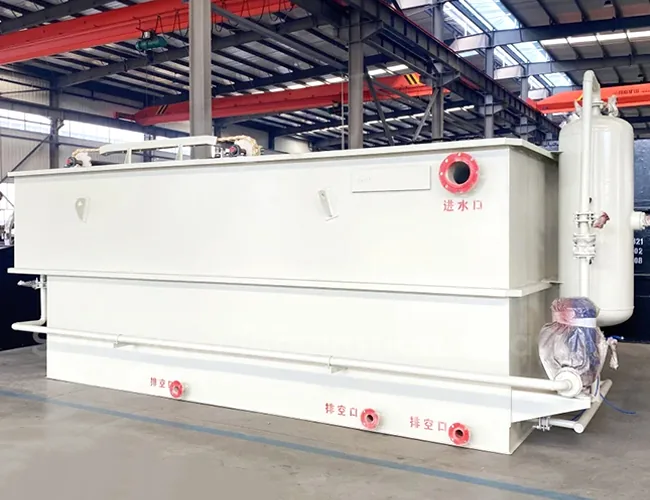
Which plants
Manufacturing and assembly
process water from washing, cooling and cleaning, where the load follows the product rather than the hours worked.
Metal finishing and surface treatment
rinse water from pickling, plating and phosphating, carrying acids, alkalis and dissolved metals that the biology cannot remove.
Textile and dyeing
desizing, scouring and dye-bath water with colour, salt and a high organic load, arriving in batches that follow the dyeing schedule.
Pulp, paper and packaging
fibre, filler and coating solids in a stream that is high in suspended solids and organic matter.
Automotive and components
degreasers, paint-booth water, oils and metal-working fluids, where the oil has to be separated before anything else.
Electronics and precision parts
low volume and high concentration, with metals and solvents present at levels the permit treats as the deciding constraint.
What makes industrial wastewater different
Two factories of the same size can produce waste streams that differ by an order of magnitude. The design follows the process, not the headcount.
- The load is set by the process — a per-capita allowance has no meaning on a factory, so the load is measured or estimated from production and the chemicals used.
- Shock and batch discharges — cleaning, tank dumping and campaign production deliver the load in slugs, so equalization carries a duty it does not carry on domestic sewage.
- pH and temperature outside the biological range — pickling and caustic cleaning can move a stream across the whole scale within a shift, and the biology needs a stable inlet.
- Pollutants the biology cannot remove — metals, oils, solvents and salts have to be taken out by physical or chemical means, or they pass through the plant and accumulate in the sludge.
- Segregation decides the cost — a small concentrated stream treated on its own is usually cheaper than diluting it into the main flow and treating everything to the same standard.
- The permit may be a trade-effluent agreement — many plants discharge to a municipal sewer under an agreement rather than to a river, and the limits in that agreement are the ones the plant has to meet.
Pre-treatment decides the plant
On industrial wastewater the front of the plant does the work. What reaches the biology has to be within its range, and what it cannot remove has to come out before it.
- 1Segregation at source — separate the concentrated, the oily, the acidic and the metal-bearing streams before they mix, so each gets the route it needs.
- 2Equalization and neutralisation — level the batch discharge and correct the pH so the biology sees a stable inlet.
- 3Oil, grease and solids separation — remove free oil, grease and settleable solids before they coat equipment or reach the biomass.
- 4Chemical treatment and flotation — coagulation, precipitation and dissolved air flotation for emulsified oil, fine solids and dissolved metals.
- 5Biological treatment — A/O, MBBR or MBR for the organic and nitrogen load that remains, with the acclimatisation the stream needs.
- 6Polishing where the permit requires it — filtration or activated carbon before a reuse duty or a tight discharge limit.
Selection steps
- 1Characterise each stream, not the combined flow — flow, pH, COD, BOD₅, suspended solids, oil and grease, metals and salinity, measured per stream.
- 2Decide what can go to the sewer and what has to be treated — the trade-effluent agreement or the direct-discharge permit sets the target for each stream.
- 3Fix the train and the site — segregation, pre-treatment, biology and polishing, then containerized or civil works on the footprint and access available.
What to send us
- Flow and analysis for each separate stream, not only for the combined discharge.
- COD, BOD₅, TSS, oil and grease, pH and temperature.
- Metals, solvents, salts and any pollutant named in the permit.
- The production schedule — batch times, cleaning windows and campaign length.
- The chemicals used in the process and in cleaning.
- The permit or trade-effluent limits, and the discharge point.
- Whether water is to be reused, and for what duty.
- Site data — footprint, access for a container, and the power supply (V / Hz / phase).
Reuse option
Where reuse is the objective, the plant can be configured to produce water for a non-potable duty inside the factory. The reuse target is fixed during sizing, because it decides whether filtration, carbon or membrane separation follows the biology.
Wash water
water returned to washing and cleaning duties where the quality allows it.
Non-potable process use
process duties that do not need potable water, agreed with the production side.
Grounds and landscaping
irrigation of the site where reuse is permitted.
Questions we answer on industrial projects
Do we treat every stream together or separately?
Separately, wherever the streams differ enough to justify it. A concentrated stream treated on its own needs a small plant; the same load diluted into the main flow forces the whole plant to a higher standard. Segregation is decided stream by stream, using the analysis rather than the total flow.
Is a per-capita sizing ever right for a factory?
No. On a factory the load comes from the process, so it is measured, or estimated from production volume and the chemicals used. Domestic allowances apply only to the sanitary flow from the workforce, which is usually a small part of the total.
Can the plant meet a sewer agreement instead of a river standard?
Yes, and many industrial plants do. The limits in the trade-effluent agreement are the design target, and they are often different from a direct-discharge permit — some parameters are tighter, others are not covered at all. Send the agreement, because it decides the train.
How much of the plant can be containerized?
Most of the train — equalization, chemical treatment, flotation and the biological stage can be built as containerized or skid-mounted units. Very large flows, or a site that already has concrete tanks, may suit civil works for part of the plant. The split is decided with the footprint and the delivery access.
What data do you need before quoting?
The flow and analysis for each stream, the permit or agreement, the production schedule and the chemicals used, and the site data. With those we can fix the train and quote it; without them the quotation would be a guess.